
 Likhita Aduri
The moment Singeetham Srinivasa Rao’s name comes up with audiences wonder what new idea he has brought this time. As a director he has explored a different genre with nearly every film he has made. He is known for breaking genre conventions ahead of his time through silent comedy, science fiction, or full length musicals long before such experiments became common, giving us memorable works like Adithya 369, Bhairava Dweepam, and Pushpaka Vimanam, a complete feature film without a single line of spoken dialogue.
At 94, the veteran director has once again ventured into new territory, this time with a musical fantasy titled Sing Geetham.
Did it live up to the expectations of today’s audience?
A film where every line of dialogue is delivered through music, did it succeed in holding their attention?
Let us talk about it
Sing Geetham movie succeeds in capturing the audience through its distinctive style of storytelling. It plays out like a fairy tale built around a simple human value. Like much of his earlier work, the film starts off with a strange or unexpected idea, only for that idea to slowly reveal itself as a way into a far more human story underneath.
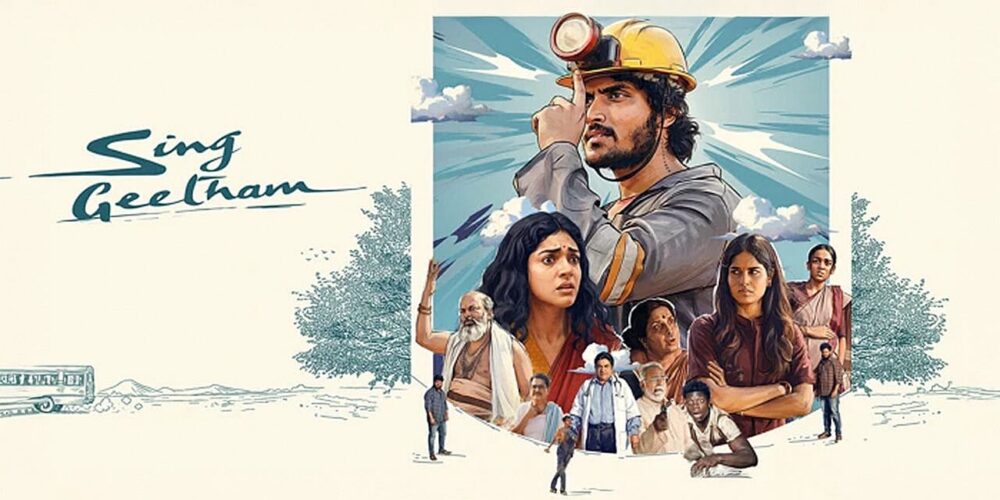
The narrative unfolds in a deserted village left with only a single tree standing. It follows Pratap (Ayaan), recently released from prison, who arrives in the village of Kuberapuram carrying his father’s property papers, only to discover that the village holds far more connection to his past than mere land.
The villagers, blinded by the promise of gold buried beneath the soil, decide to cut down that last tree; the same tree Gauri (Ahilya Bamroo) holds dear as a memory of her mother. Heartbroken, Gauri appeals to the village deity, Lord Kubera, against the injustice carried out by Renu, the owner of the gold mine (played by Shalini Kondepudi), and the villagers who support her in their pursuit of wealth.
Angered by this, Lord Kubera curses the entire village. From that moment, the villagers lose the ability to speak in ordinary language. Every word that leaves their mouths becomes a song. Love, anger, fear, grief, and confession must all be expressed through music. Even the sounds of birds and hens are transformed into song.
The film’s musical journey begins with “Emaindhi Emaindhi,” a song that captures the villagers confusion and distress over their newfound inability to speak normally. This song is lighthearted and entertaining.
However, in certain portions of the first half, some scenes feel forced as not every dialogue can be tuned into a song .
This shortcoming fades by the second half, which shifts its focus toward the emotional core of the story. Singeetham Srinivasa Rao’s narration here evokes a childlike sense of wonder, carrying the warmth and charm often associated with stories told by a grandparent.
Pratap’s (Ayaan) journey develops into something more emotionally resonant than initially expected. Both Ahilya and Shalini deliver committed performances. Ahilya’s Telugu dubbing and singing may feel slightly off at first, but her sincerity and growth through the second half ultimately win the audience over. Tulasi, in particular, delivers a performance so natural that it rarely feels like acting at all. The production design of Kuberapuram appears somewhat artificial in a few sequences, though it largely holds up well. A notable highlight is that every actor performed their own singing for the film.
The appearances of Ravindran and Nivetha Pethuraj add another dimension to the narrative, and the cameos toward the film’s conclusion arrive as a pleasant surprise. Watch the film to know who gave a cameo presence 🙂
Special mention must be made of the music director, Devi Sri Prasad, whose composition and background score stand out as one of the film’s strongest elements. Converting nearly every line of dialogue into song while keeping the narrative engaging is no small feat, yet DSP accomplishes it with remarkable skill.
Audiences were left humming “Emaindhi Emaindhi” long after leaving the theatre, and his composition during the film’s climax elevates the story to another level altogether.
Sing Geetham is far more than a musical fantasy; it carries a meaningful human lesson at its heart. Although the story was written nearly four decades ago, its message remains just as relevant to today’s generation. The film gradually develops each character, illustrating how unity and humanity ultimately triumph over greed and self interest.
Sing Geetham makes little effort to dazzle its audience. Unlike several pan India films that have struggled to engage viewers while focusing more heavily on promotion than substance, this film is determined to quietly hold its audience’s hand and tell its story.
It actually feels nice seeing the old “Subham” card again at the end of the film, something you don’t see much anymore. And by the time “Singeetham’s Cinema” shows up on screen, you don’t really care about the small flaws in the film. You just leave the theatre happy that you got to watch a good story, told by someone who’s been doing this for a lifetime who’s none other than Indian cinema’s most enduring storytellers Sing Geetham Srinivasa Rao Garu.
This is a film worth experiencing in theatres.
*


 పెద్దన్న మారబత్తుల
 సుజాత వేల్పూరి
 మునిసురేష్ పిళ్లె
 శాంతి ఈశాన్
 మానస ఎండ్లూరి
 భరత్ కనికె
 ముక్కామల చక్రధర్
Add comment