
 Nabanita Sengupta
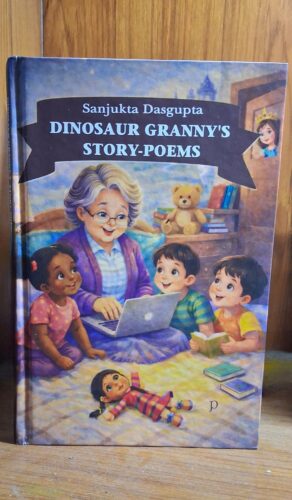
The phrase ‘Dinosaur-granny’ evokes a warm, fuzzy feeling in me as a reader. Childhood associations that my son, now about to step into adulthood, had with dinosaur, comes back with all its psychedelic associations. I remember the several dinosaur toys and dinosaur motif merchandise that thronged our house then. And then, when a granny calls herself a ‘dinosaur-granny’, all these associations melt into one timeless, affectionate anchorage of childhood that one can look back with nostalgia.
Then the question arises, who is this dinosaur granny? My interactions with Prof Sanjukta Dasgupta had been at the very beginning as a student-teacher relationship. Later, with our several academic ventures, I came to know her as an erudite scholar, a distinguished academician but one with a keen sense of wit, a feminist, a poet, and much more. But none of these fit the persona of the dinosaur granny, the self-imposed role that she takes upon herself. Not till I had turned the pages of her latest book, Dinosaur Granny’s Story Poems. There the academician, the feminist, the scholar, the teacher, all roll into one persona of the grandmother who loves to tell stories to her grand daughter. These stories, tumble out into the world in the form of this book, waiting to be read by the children, their parents and grandparents.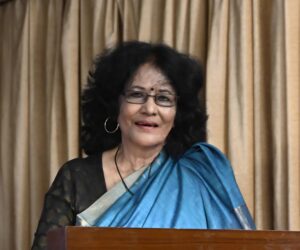
Writing for children is not an easy task. It becomes even more daunting after being engrossed in writing academic papers, voluminous books and all the serious stuff that an academician has to do. As a poet too, Sanjukta Dasgupta had mostly been more involved in writing about feminist, social and political concerns. But in this book, she effortlessly steps into the persona of a grandmother, engaged and engrossed in the world of her grandchild. Does that mean that all her other personas remain dormant in these compositions? Well no. What we find is a beautiful amalgamation of fantasy, imagination, social concerns, ecological awareness, tradition and intellectuality – all present in these poems. But these concerns have been voiced in a way that can appeal to the young, growing minds and can be understood by them.
Like all her roles in life, Sanjukta Dasgupta takes up the role of granny seriously too. She actually delves into the world of her grand-daughter, looks at it through her eyes, and tries to understand a childhood that is far removed from her own. The world of Gen Alpha, surrounded with devices and AI, is far removed from the world in which she had grown up or raised her own. But dinosaur granny crosses the generation gap with a big leap and communicates with the child with a mix of playfulness and earnestness. She introduces the child to all that she considers significant and as we read the story poems, we realise how valuable these are.
The opening poem is a playful interaction between the child and her granny where the child affectionately adorns her with the moniker, ‘Dinosaur Nanny’. She has a logic behind it and says – you are a sport/ not a spoil sport/ You are so tall/ My neck aches as I/ Look up to see you/ My funny Dinosaur Granny. For those who are familiar with the wit of Sanjukta Dasgupta, you will find a glimpse of it in the first poem itself, dressing it in a style suitable for the young ones.
What is ‘grandparenthood’ if not stories! This dinosaur granny takes up her role as a story teller too. The poem, ‘Tell me a Story’ is a gentle reminder of how human negligence can cause a pet’s death. There is a similar concern in the poem ‘Bulbulie My Little Birdie’ where it is not negligence but lack of experience that results in the death of a pet bird. Dinosaur Granny fills her granddaughter’s world with creatures that live around us –birds, hen, butterflies, snakes and mongoose, and even mosquito! What better way to make a child aware of her surroundings if not through story-poems!
Charles Lamb, says in the ‘Dream Chilcren: A Reverie’ “Children love to listen to stories about their elders, when they were children…” There are several poems in this collection where the poet talks about her childhood to her granddaughter. In ‘Playtime’ and ‘Stage Fright’, granny talks about her childhood experiences in response to the little one’s questions. In the poem, ‘Devices’ too, she talks about her growing up years, adding to it the technological revolution that began, bringing the world to its current state.
The Dinosaur Granny also introduces the child to the traditions and festivals of her community. ‘Saraswati’ is a delightful read where the poet says, “Google and AI may know a lot/ But they cannot beat/ Goddess Saraswati”. The granny, as Basudhara Roy rightly observes in the Foreword, has done her ‘homework’ right and knows how to make tradition more accessible to the Gen Alpha kids. She introduces the child to Ishwar Chandra Vidyasagar, Nazrul Islam and Rabindranath Tagore – giving a glimpse into the rich intellectual and cultural traditions of Bengal. But she also does not miss to talk about Harry Potter and Wimpy Kids – how else could there be a bridge built across generations! We also get to see the feminist scholar behind the persona of granny in the poem ‘Barbie’ which says, “O my beautiful Barbie Doll/ Being pretty like you is not my goal”. Freedom and ecological concerns are some of the other areas into which the granny introduces her little one.
Dinosaur-Granny’s Story Poems are a delightful read for everyone who enjoys children’s literature. What is most remarkable is the range of issues that are addressed here. There is no pedagogical tone even in the poems which deal with serious concerns. All the poems have a playful note but they convey some deep truths of life. It is a book of poems for children, but with a difference – neither harking back to the past, nor being preachy. The poems communicate with the child at her level, carrying an innocence but not naivety.
*
Dinosaur Granny’s Story-Poems by Sanjukta Dasgupta
Penprints Publications, 2026
pp-146
Price – Rupees 499


 పెద్దన్న మారబత్తుల
 శివలక్ష్మి
 Chandana Alluru
 విశీ
విశీ
 సంజయ్ ఖాన్
 ముక్కామల చక్రధర్
 శ్రీరామ్ పుప్పాల
Add comment