
 Ramarao Kanneganti
One of our neighbors, the patriarch of a large family, disappeared.
Our entire street was really one large house. At some point in the past, it had belonged to a single family. Over the years, it got partitioned and repartitioned until it became a row of homes, one family in each compartment, all sharing walls, courtyards, memories, and games.
People searched everywhere. Relatives went to nearby villages. Friends checked bus stands. After a day or two of increasingly desperate searching, somebody suggested consulting a man who supposedly possessed occult powers. He could locate missing people, provided there was an innocent person who could identify the location from the vision.
They needed a child. An educated child.
As an eight-year-old, I already knew a few poems by heart and could recite multiplication tables reliably. I was chosen because of these two signs of education: poetry and arithmetic.
Looking back, I find it amusing that nobody explained why these two abilities belonged together. Yet for generations they were considered the twin pillars of education. A child who could read and calculate was considered educated. They simply coexisted.
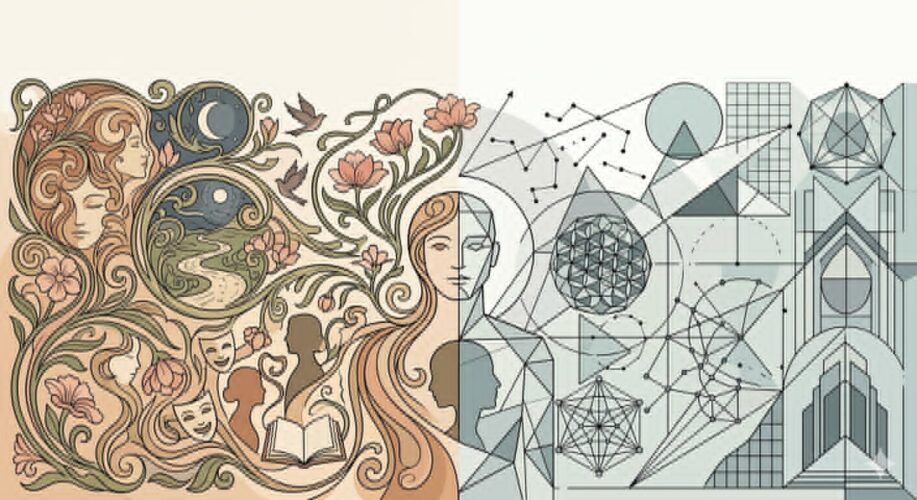
As I grew up, however, the two seemed to drift apart. Reading belonged to one world. Mathematics belonged to another.
Much of my childhood reading consisted of stories about people living at the edges of society. The tropes are all there: the orphan girl who attracted the attention of a proud hero; the villager mocked by city people; the poor family struggling against a rich landlord. Later, as I grew older, the characters changed but the structure remained the same: the labor leader, the corrupt factory owner, the reluctant revolutionary, the social reformer.
Looking back, I realize that stories are rarely about ordinary life.
“Dog bites man” is not a story. As Tolstoy observed, all happy families are alike; each unhappy family is unhappy in its own way. Stories focus on the unusual, the exceptional, and the conflicted. They concern themselves with love, betrayal, sacrifice, courage, injustice, and redemption. A war turns a bully into a warrior. A child transforms a villain into a loving father. A crisis reveals a person’s character.
Stories live at the boundaries.
Some literature went further. It consciously tried to explain a political or social philosophy: egalitarianism, traditional values, scientific temper, or social reform. These stories attempted to shape the values of their readers.
In those days, I saw mathematics as operating on aggregates: statistics, groups, sets, and entities defined by their similarities. There seemed to be no place for judgment or ambiguity. The essential human value of individuality appeared lost in mathematical analysis. Perhaps that is why I thought mathematics was fundamentally different from storytelling.
Overall, literature gave me a framework for understanding people. It taught me empathy. It taught me to inhabit perspectives different from my own. More importantly, it convinced me that thoughtful people naturally gravitated toward books.
Then I went to IIT.
There I met many thoughtful people who had never read Dickens, Sarat Chandra, Sri Sri, or much fiction at all. Yet they possessed a remarkable ability to reason about the world.
In one discussion, a friend defended moral relativism so effectively that I could not find a convincing counterargument. In another, while discussing constitutions, somebody pointed out that explicitly enumerating freedoms can sometimes narrow them.
The surprise was not that they had never read the books I considered important. The surprise was that they often arrived at similar insights through entirely different routes.
That realization stayed with me.
I had assumed literature possessed a monopoly on understanding human beings. Clearly it did not. There were other paths to the same destination.
Once I began noticing this, I started seeing how our thinking is shaped by the tools we use. The analogies we make, the abstractions we create, the distinctions we draw, and the stories we tell ourselves all come from what we read, learn, and experience.
In my final year at IIT, I read Douglas Hofstadter’s Gödel, Escher, Bach. The book discusses two intellectual habits: finding similarities between things that appear different, and distinctions between things that appear similar.
The first habit felt immediately familiar.
Much of literature works by exploiting similarities. When a poet compares a face to the moon, or invokes flowers while describing a scene, the power comes from connecting known ideas. When we read a novel, we recognize ourselves in people separated from us by geography, language, class, gender, or even centuries.
Mathematics does something remarkably similar.
A falling apple and a planet moving through space appear to have little in common. Yet Newton saw them as manifestations of the same phenomenon. Mathematics repeatedly discovers structures hidden beneath surface differences.
The second habit is equally important.
Good literature breaks stereotypes. It reminds us that two people who appear similar may be profoundly different. Much of modern literature, especially literature dealing with identity, culture, and social experience, is devoted to recovering these distinctions and nuances.
Mathematics also progresses by making distinctions.
Prime numbers and composite numbers both appear to be ordinary counting numbers until we ask the right question. Rational and irrational numbers look similar until we examine their structure. Again and again, mathematics discovers important differences hidden beneath apparent sameness.
The more I think about it, the more I find these two worlds illuminating each other.
Stories train us to navigate the complexity of human experience. Mathematics trains us to navigate the complexity of abstract structures. One teaches us to understand motives, emotions, and values. The other teaches us to understand patterns, relationships, and models. Both require imagination. Both require discipline. Both demand that we look beneath appearances.
This column is too short to explore all the connections between them. But over the years I have become less interested in the differences between stories and arithmetic, and more interested in the habits of mind they share.
As for the missing neighbor, the séance never happened. Before they could take me to the occult expert, the missing man returned home. He had not been kidnapped, enchanted, or lost. He had simply decided that life in a large joint family was exhausting and wanted a few days of peace.
As a child, I was disappointed. I had been looking forward to witnessing visions and identifying mysterious locations.
Looking back, however, I think the ending is fitting.
The storyteller in me wanted a mystery. The budding mathematician wanted evidence of supernatural powers. Instead, there was a perfectly ordinary human explanation.
Perhaps that is where these two worlds finally meet. Stories teach us to imagine extraordinary possibilities. Arithmetic teaches us to look for underlying patterns and explanations. Between stories and arithmetic, between imagination and explanation, lies much of what we call education.
*

 పెద్దన్న మారబత్తుల
 శివలక్ష్మి
 Chandana Alluru
 విశీ
విశీ
 సంజయ్ ఖాన్
 ముక్కామల చక్రధర్
 శ్రీరామ్ పుప్పాల
Excellent analysis and brilliantly written article