
 V. Satya Sudha and V. A. S. Sasirekha
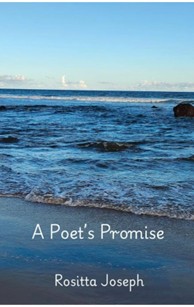
With the publication of her first book of poems, “A Poet’s Promise”, Rositta Joseph has proved that she is not just a budding but a promising poet. As Dr. Nishi Pulugurtha writes in her appreciation: “The 63 poems in the volume reveal a sensitive poet’s response as she negotiates the web of life. Nature, tradition, myth, history, coalesce in the poems creating a tapestry of an experienced world. Written in an idiom that is simple, yet vivid, these poems create a world of thought waiting to be explored” (https://www.rosittajoseph.com/books/a-poet’s-promise).
Her love for nature goes beyond admiration for natural beauty to deeper reflections on human life:
The humanity of animals is infinite
Just like the bestiality of humans. (“Animals, Humans”)
Her belief in the unparalleled supremacy of true love is reminiscent of John Donne:
Ages ago our souls
Lost each other
Now they collide and dissolve.
With the infinite energy
Of pure atoms. (“Alone Together”)
Elsewhere, poems such as “Eros”, which voice the trauma of losing a loved one to a terminal illness, offer both catharsis and consolation. In “Father’s Day”, she bares both the eternal charm and the pathos of her relationship with her father.
This spirit of love extends to her pluralistic outlook that embraces temples, churches and mosques alike. Rositta’s poems on “Places” not only reveal the magic of India but also foreground the spirituality and universality of all these destinations:
All the sorrow of the world
Rushes to your feet, Mother
Hearing of agony is one thing
Seeing so much of it, unbearable. (“Velankanni”)
Likewise in the poems on the famed temples of Puri and Tanjore, primacy is always accorded to the nameless toiling generations who lose themselves in the quest for the divine.
Moving from the personal to the social, “The Disrobing of Draupadi” reflects the continued insult of womanhood from the Mahabharata to the present times. Again, she brutally satirises the accomplishments of the AI era, wherein human beings have turned into
Permanent actors
With masks
Stitched to our souls. (“Post Truth”)
However, the poet fights back, determined to move forward despite a grossly unfair system:
All is never lost
For
Those who walk
The straight and narrow path
In a crooked world. (“Return to School”).
Right from the brave Queen of Jhansi (“Lakshmi Bai”) to the women of Mumbai who fought for peace amid the horrifying 1992-1993 communal riots (“The Phoenixes of Bombay”), the poet never misses a chance to honour the brave, revealing her “poetry of commitment, the strident voice of her social conscience writ large…” (Arjuna Parakrama, p.8. ‘A Poet’s Promise’).
Finally, it is all about survival:
I have fallen from the sky
A hundred times
Surviving
Only because
Someone
Had softly spread
My dreams
On the ground. (“A Fine Balance”)
As Dr Basudhara Roy observes: “In Rositta Joseph’s hands, poetry engages deftly with the world’s despair and angst, conjuring a balm that is as precious as it is potent…these poems are both retribution and resurrection.” (Blurb/Appreciation, ‘A Poet’s Promise’).
A Poet’s Promise | Poetry | Dr. Rositta Joseph Valiyamattam | Black Eagle Books, USA (2025) | ISBN: 978-1-64560-662-8 | LCCN: 2025933749 | Paperback | Pp 168 | ₹350
*


 పెద్దన్న
 Lopamudra Banerjee
 Akriti vigya 'Arpan'
 అఫ్సర్
 విశీ
విశీ
 అరిపిరాల సత్యప్రసాద్
 శ్రీరామ్


Add comment