

 Mahua Sen
I have a fascination for “evenings”, especially, for Godhulibela – the cusp of late afternoon and evening. The moment I read the title, Evening with a Sufi, the idea of an “evening dialogue” popped in my mind and it instantly reminded me of the spirit of Plato’s Symposium, where thinkers gather not only for conversation, but to explore identity, the nature of existence, the philosophical nature of love, and the truth in the rawest form.
Similarly, the exploration of “evening” echoes Friedrich Nietzsche’s twilight imagery in Twilight of the Idols, where the fading light symbolizes the questioning of established truths and dismantles false dogmas of western culture. With that in mind, I embarked on a journey of reading Evening with Sufi by Afsar Mohammed, which is a deeply reflective collection that eloquently dawdles between memory, a sense of home, displacement, loss, hope and hopelessness. I finished reading the book in one sitting and re-read it multiple times. I think that’s the beauty of a poetry book, every time you read it, a new understanding, a new meaning comes to life. Often, the one you had missed the last time around. The poems in this collection carry a subtle yet piercing tone where personal grief merges with collective history, and language itself feels wounded.
When we think about Sufi philosophy, we instantly remember Jalal al-Din Rumi, whose poetry often seems like a personal conversation, between the self and the self or, between the self and the divine, and sometimes, between longing and fulfilment. The “evening” in that sense, becomes a time when the ego softens, allowing deeper spiritual awareness to emerge.
In Indian poetic and philosophical traditions, this mood finds echoes in Kabir, whose verses often feel like direct, personal conversations with the self and the divine. Kabir’s poetry, like Afsar Mohammed’s, strips away ornamentation and speaks in a deceptively simple voice about profound truths of belonging, loss, and the illusion of identity. Similarly, Agha Shahid Ali writes of exile and longing in a tone that feels like a late-evening meditation, where absence becomes tangible.
Evening with a Sufi, translated from Telugu by Afsar Mohammad and the renowned poet and translator Shamala Gallagher and published by Red River, opens the trapdoor of a shared human condition- sitting at the edge of light and darkness, the chiaroscuros of searching for meaning in conversation, memory, history and silence. These poems are selected from several of Afsar’s poetry volumes in Telugu which reflects the diversity of the poet’s work.
In that sense, the title can be considered as an imagined gathering, a rendezvous with a Sufi, perhaps a poet, a saint, or even an inner voice, where stories of exile, memory, and pain are shared. In Sufi philosophy, separation and yearning are central experiences, and this sensibility runs through the poems in this collection. The “evening” becomes a symbolic space where the poet confronts both personal and historical wounds yet also seeks transcendence and release. Thus, the title is not merely descriptive, it frames the entire collection as a reflective encounter, an inward journey where poetry becomes a form of meditation, memory, and resistance.
At its core, Evening with Sufi is a meditation on belonging and rupture. Afsar Mohammed writes like someone standing at the edge of multiple worlds, watching the world from different vantage points, where village and city, past and present, language and silence merges . His poetry is deceptively simple, but each line opens into layers of emotional and historical meaning, evoking a whirlpool of emotions.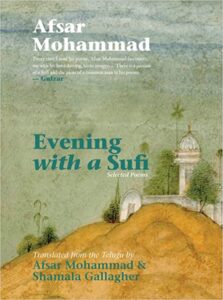
In Mother’s Hand , he writes,
“As you leave the village,
I hope the waters
Of the nearby stream
Rise to see you off
Like your mother’s hand.”
“When you reach the village,
I hope the stream rises to meet you
Like your mother’s hand.”
These lines evoke a cyclical sense of departure and return. The stream becomes a living presence, embodying maternal affection. The imageries reflect the fact whether leaving or arriving, the mother’s love remains untainted and constant, ever caring, fluid, selfless, and protective. The repetition of the image suggests that home is not just a place, but an emotion found deep within. It is more about the soul than the soil. A place of return. The tenderness here recalls the emotional spectrum of Rabindranath Tagore, where nature often mirrors human sensibilities and spiritual connection.
In Evening with a Sufi, the poet writes,
“Now I watch a sparrow
With its bleeding beak
Writing something on the grave
Translating its pain
Where will I go now?”
“There is a grave
to dig
Within me.”
This poem, written in memory of Vali Gujarati, whose grave was destroyed during the 2002 Gujarat riots, is one of the most haunting in the collection.
The sparrow with a “bleeding beak” becomes a metaphor for stifled voices and violated histories. Poetry itself is depicted as an act of translation of pain into verses. The final lines turn inward. The catastrophe outside mirrors an internal mayhem. Here, Afsar Mohammed’s work resonates with Faiz Ahmed Faiz, especially in how political trauma is expressed eloquently through intimate imagery.
Similarly, in Othershore he writes,
“Please will you sing for one more lifetime.”
The reference to S. D. Burman connects poetry with memory through music. The “othershore” suggests a metaphysical space. Perhaps death, pain, exile, or memory itself. This closing plea reflects a longing for continuity beyond time, echoing the melancholic musicality found in poets like Gulzar, where nostalgia and longing blur into one.
In No Birthplace, the poet writes,
“I roam through country after country
Imagining that each one is mine…
But not even a bee can tell me my address.”
This poem captures the existential condition of displacement. A longing to belong. The pain from a sense of homelessness. The speaker’s identity dissolves across borders yet nowhere offers belonging. The bee is symbolic of nature and instinct which cannot locate the poet, emphasizing a heart wrenching alienation.
This theme reminded me of Agha Shahid Ali, whose poetry also dwells on exile, memory, and the impossibility of return.
In The Accented Word Afsar writes,
“Words
are stillborn babies.”
“My voice is in chains
And my language is poisoned…
We live on the brackish water of life.”
This poem offers powerful imageries where language itself becomes a site of violence. Words fail before they are born, expression is stifled. The “poisoned language” perhaps suggests cultural and political corruption. This linguistic despair reminds us of T. S. Eliot’s The Waste Land, where language fragments under the weight of modern crisis.
In one of my favourite poems from the collection, Childhood Lake, the poet writes,
“There used to be
Little water here…
They felt a cool touch like mother’s hands.”
“But now it screams
With all the dryness
In the hurt pit of the earth.”
This poem begins with nostalgia but ends in ecological and emotional devastation. The lake, once akin to a doting mother, morphs into a dry and wounded space. The transformation reflects both environmental degradation and the loss of innocence. This blending of personal memory with environmental grief is reminiscent of Seamus Heaney, who often connected landscape with identity, memory, and history.
Afsar Mohammed’s Evening with a Sufi is a powerful collection and its strength lies in its restraint. He does not aestheticize, he doesn’t over-explain, but allows images to do the talking, to carry emotional and political weight. Themes of exile, memory, language, and loss recur, but each poem approaches them from a fresh, intimate angle, creating ripples of emotions in the minds of the readers. The result is poetry that feels both deeply rooted and profoundly unmoored.
*
For copies: here on amazon


 పెద్దన్న మారబత్తుల
 శివలక్ష్మి
 Chandana Alluru
 విశీ
విశీ
 సంజయ్ ఖాన్
 ముక్కామల చక్రధర్
 శ్రీరామ్ పుప్పాల
Good introduction. Love it.