
 Swapna Peri
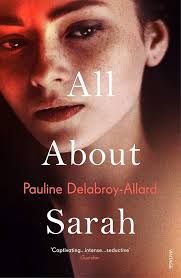
Book Title: All About Sarah
Author: Pauline Delabroy-Allard
When I picked up “All About Sarah” by Pauline Delabroy-Allard, I expected a love story—but what I experienced felt far more intense and unsettling. This isn’t a gentle exploration of romance; it’s a deep dive into what love can do when it takes over completely.
I was immediately drawn into the narrator’s world, especially in the early chapters. Her life begins in a quiet, almost restrained space, and then Sarah arrives—sudden, loud, and impossible to ignore. I found those first moments of connection incredibly engaging. The writing made me feel the rush, the excitement, and that almost addictive pull of being noticed and desired.
Sarah, as a character, really stood out to me. She felt less like a person and more like a force—unpredictable, magnetic, and slightly dangerous. I could understand why the narrator was so captivated by her. At the same time, there was always something unsettling about Sarah, as if her intensity carried the seeds of its own destruction.
As the story progressed, though, I felt my engagement begin to shift. The passion that initially felt electric started to feel overwhelming and, at times, repetitive. When the narrative moves into the second half, especially around illness and separation, I found it harder to stay emotionally connected. The energy that Sarah brought seemed to disappear, and with it, some of the novel’s momentum.
I also struggled with the narrator at times. Her choices—especially the way she distances herself not just from Sarah but from others in her life—made it difficult for me to fully empathize with her. I understood what the author was trying to portray about obsession, but I still found myself frustrated by her emotional withdrawal and self-absorption.
At its core, “All About Sarah” explores obsessive love—love that consumes, distorts, and ultimately destabilizes. I found that the novel treats love not as comfort, but as something volatile and almost dangerous, where desire and suffering become inseparable. The tone shifts between lyrical intensity and a kind of emotional numbness, which mirrors the narrator’s own journey. The writing feels intimate and immersive, often leaning into a stream-of-consciousness style, with sensory details—smell, sound, touch—bringing the emotional experience vividly to life.
I also noticed how the book draws from a wider cultural and artistic space, with echoes of All About Eve and references to filmmakers like François Truffaut and Jacques Tati, which subtly shape the narrator’s worldview. To me, the narrator feels driven by a deep need to break out of her controlled, predictable life. When Sarah enters, she represents everything the narrator is not—free, impulsive, alive. I could sense how quickly admiration turns into dependence. The narrator doesn’t just love Sarah; she orbits around her.
That said, I can’t deny the beauty of the writing. Adriana Hunter’s translation captures a lyrical, almost poetic quality. I particularly loved the descriptions of Paris, the presence of music throughout the novel, and the way certain sensory details—like scent and sound—became tied to memory and emotion.
In the end, I see this as a novel that will divide readers. For me, it was powerful in parts and exhausting in others. If you’re someone who appreciates intense, emotionally charged stories about love at its most consuming and destructive, this book will likely resonate with you. But if you prefer more balance, clarity, or character growth, you might find it a challenging read.
*


 పెద్దన్న మారబత్తుల
 Chandana Alluru
 విశీ
విశీ
 సంజయ్ ఖాన్
 ముక్కామల చక్రధర్
 శ్రీరామ్ పుప్పాల
 మౌని
మౌని
Add comment