
 Lelle Suresh
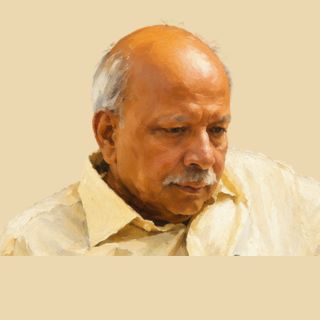
To many, KS Gopal was a visionary of sustainable development and agricultural innovation, a thinker deeply rooted in questions of land, ecology, and justice.
But beyond all his public contributions, he carried something rarer —the ability to make people feel instantly close to him.
Some people leave memories.
Some leave warmth.
Lelle Suresh
Dear Gopal Sir,
I still do not understand how some people enter our lives so suddenly and become impossible to forget.
I had no idea about you until the day we met at a friend’s place in Hyderabad. You were already around seventy by then. But from the very first conversation, something in me opened toward you. It was immediate. Your smile, your childishness, your endless talking, your careful politeness, your love for people, even the glass in your hand – everything around you carried warmth.
You smiled, smiled, and smiled.
After that, every gathering felt incomplete until you arrived. I would unconsciously wait for your voice somewhere near the door. Once you came, the room changed. You never sat like a guest. You spread yourself into conversations, into laughter, into stories. You spoke beautiful English without making anyone feel small. You listened with the same attention with which you spoke.
Some people create closeness slowly.
With you, closeness arrived immediately.
You used to come home for our Christmas celebrations too. I wonder how the coming Christmas will feel without your presence.
You loved my family, especially Cimba and Kuhoo. You listened to their music with genuine happiness, as though their songs belonged to you too. You watched our performances not as formality, but with affection, with involvement, with pride. Sometimes I felt you enjoyed our joy more than we ourselves did.
You appreciated my songs many times. Every appreciation from you felt honest because you never praised people carelessly. Today, I feel like singing one of my songs for you again. But this time, instead of singing, I want to sit quietly and read my latest poem to you, a poem born from the silence your absence left behind. Somewhere, I hope you are listening with that familiar smile, and when I finish, I hope you nod gently in appreciation the way you always did.
I still remember one of our programmes when the Warsi Brothers were performing qawwali and ghazals. Everybody appreciated them, but you did something more beautiful. Quietly, happily, you gifted them five thousand rupees out of pure admiration. It was never about money with you. It was your way of hugging art.
That was your nature.
Whenever I hosted gatherings at my home, you would always offer some contribution. Every single time, I would tell you, “It is my pleasure, Sir. I do not want to share it with you in that sense.” And every single time, you would smile in that mischievous way and somehow make me smile too. You never insisted with ego. You insisted with affection.
And your food memories, Sir – impossible to forget.
Your favourite mutton kheema. You called it “sexy kheema” with full excitement. And chapathis beside it, compulsory. Even now, whenever I see kheema, I see it as sexy kheema.
But food for you was never only food.
It was companionship.
I can never forget the evening at your home when you prepared vegetable soup for me. You made soups with such care, such surprising delicacy. That day you served the soup with Chivas Regal whiskey. The soup was tasty. The whiskey was tasty. But more than both, your affection was tastier than anything on that table.
You had that rare ability — making ordinary evenings unforgettable.
You were also a heavy smoker, Sir. One evening, I accompanied you to the balcony while you were smoking. I was a smoker too. You smoked Gold Flake Kings. I still remember the way you held the cigarette — slowly, thoughtfully, as though conversation itself was rising with the smoke. That day, after lighting it, you could not complete it. But you also did not want to throw it away. Quietly, almost casually, you handed it to me and asked me to finish it. I did. Strange how such a small moment remains alive in memory. Even now, when I think about it, it does not feel like sharing a cigarette. It feels like sharing silence, trust, and companionship without needing many words.
You were deeply connected to nature too, Sir. Not in a fashionable way, but with real understanding and affection. You spoke about crops, trees, soil, seeds, and the violence hidden inside fertilizers and chemicals. One evening during a gathering, someone casually asked you about trees that were growing unevenly. I still remember your response in fragments, but its spirit remains clear inside me. You said trees have their own individuality, almost like human beings. We should not cut them down or force them simply because they are not growing straight or beautifully according to our expectations. They choose their own shape, their own direction, their own freedom. The way you spoke about trees felt as though you were also speaking about human beings.
And your humour, Sir – so sharp, so effortless.
Once we went to a friend’s village house in Mahboob Nagar district with a group of friends. There was a huge old tamarind tree standing in the wide-open space beside the house. All the women in our group became busy under the tree – plucking tamarind fruits seriously, laughing, taking photographs. Looking at all the excitement, I asked you, “Sir, shall we also go there and see the tree?”
Without even a second’s pause, you said very seriously, No. I was warned that there are woman-devils under tamarind trees. I am afraid of them.
The way you said it — with that perfect seriousness hiding mischief — we burst into laughter immediately. You carried humour so lightly. Even your jokes never tried to dominate a room. They simply opened happiness inside it.
And behind all your laughter, there was also courage.
Many people only speak about justice in meetings. You actually stood beside people during difficult times. Though you were one of the founders of the Deccan Development Society in Hyderabad, you still stood with thousands of women in Zaheerabad when they raised questions about dignity, accountability, and control over their own money. I always felt that this revealed something deeply honest about you — for you, people were more important than institutions, even the institutions you helped build yourself.
I still feel proud remembering that I could contribute, even in a small way, by recording and editing your interview video to build solidarity from civil society in support of those women. Your voice carried honesty. Not performance. Not slogans. Conviction.
Even your old scooter now feels like part of your personality.
Weak brakes, a broken number plate – still, you drove it so confidently and safely.
One night, after enough whiskey at a friend’s place, almost around 10:30, we both travelled on that scooter through the night. Any other person would have frightened me. But with you, strangely, I felt safe. You drove carefully, steadily, while continuing beautiful conversations as though life itself was moving beside us in the dark.
Even now, I cannot decide what I remember more from that night— the road, the whiskey, or your voice flowing continuously through the air.
When I last met you after the cancer diagnosis, you did not speak like a defeated man. You said you would come out of it. You said you would continue fighting for women’s rights. Even then, you were thinking beyond yourself.
That was you, Sir.
I never told you this properly, but your presence gave me rest.
In a world where people constantly measure each other, you carried no such burden. You came toward people lightly. Freely. Like someone who had quietly escaped something heavy long ago.
And perhaps that is why everybody around you relaxed.
When I heard about your illness, it did not feel real. I could not imagine your smiling face carrying that much pain silently. Tongue cancer — what a cruel thing for a man whose life itself felt like conversation.
And then, suddenly, you were gone.
But strangely, you are not absent.
Even now, in gatherings, there are moments when I still expect you to appear. Sometimes while performing, I remember the way your face brightened during our performances. Sometimes in the middle of laughter, I remember your voice entering the room before your body did.
You left behind a strange vibration, Sir.
Not sorrow alone.
Something softer.
You reminded me that affection does not always need years. Sometimes two human beings simply recognize each other beyond all the usual distances of the world.
That recognition itself becomes friendship.
You came into my life unexpectedly.
And without asking permission, you stayed.
With love,
Lelle Suresh


 పెద్దన్న మారబత్తుల
 మునిసురేష్ పిళ్లె
 శాంతి ఈశాన్
 మానస ఎండ్లూరి
 భరత్ కనికె
 ముక్కామల చక్రధర్
 ఏ.కె. ప్రభాకర్
Add comment