
 Nishi Pulugurtha
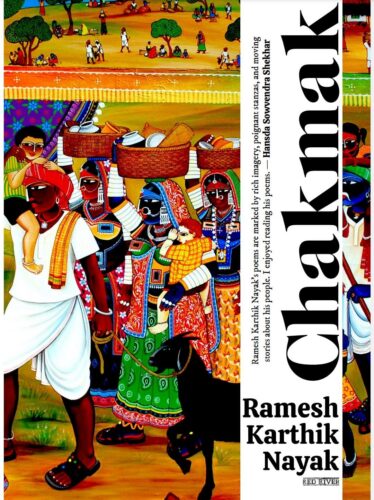
An artwork by Ramavath Sreenivas Nayak adores the cover of the volume of poems under review. The bright cover, done so evocatively, draws one into the world of the Banjara community located in Telangana. This is the world of the young, Sahitya Akademi Yuva Puraskar winning bilingual poet and author, Ramesh Kartik Nayak. A world that Nayak brings to the centre of his work, revealing the joys, sorrows, moments of life in its myriad negotiations. Chakmak is Nayak’s first published work in English and contains 35 poems.
The poem “Trees” begins in a matter-of-fact way and takes us into a world where nature co-exists with human beings – “Grandmother said/trees are my ancestors.” The poem then goes on to speak of history, of the speaker’s recognition of the people of his community and their history – “I should read my history/ flowing in my veins.” The sense of belonging to the land, to the community, of claiming one’s identity is seen in many poems in the volume. In the poem “Night”, for instance, the speaker notes –
Mountains shed their identity,
trees spread their roots
into tender parts of the earth.
The poem ends with the speaker searching for roots that remain enmeshed in memory.
The hamlet, the people, their songs reverberate through many of the poems. Their simple joys and insecurities linger on in the poems. In “Celebration’ he speaks of the community, all gathered together-
Women circle around the bonfire and sing,
men beat frame drums,
children touch nangara.
There is a vividness in the way Nayak describes it all, with the sky, the silk cocoons, the pollen all creating a sense of place and memory.
In “Red-velvet Mites” the poet uses the image of the mites, a rather unconventional image, to speak of the world of the tanda, the hamlet.
Tribes offer prayers
to the sickened and weakened earth,
sending a few words to the sky.
The natural world blends in with the social spaces of the community and reveals a kind of symbiotic relationship. In several of the poems the poet uses words that the Banjara community uses, the meaning of the words are mentioned in a glossary to the poems. The use, this reviewer feels, allows the poems, their images, to be rooted in a specific world. Nayak is a poet whose identity as a Banjara poet is clearly made evident in whatever he writes. The ancestral voices of the community is heard in the poem “Ancestors”-
Our ancestors
stash the buds they gathered,
buds turn into golden seeds,
they sow them in the soil of the sky
to harvest human beings.
Voices like these are there in several poems. They are voices that the poet has heard, voices which he wants the world to hear, voices in which the human and the non-human exist in a harmony.
Like many a young poet seeking meaning, a poem like “A Valley” voices angst that the speaker is trying to come to terms with.
The dream set stage for its rehearsal,
asked me to don a role in the play.
The emptiness, the world that tends to crush, linger on in the poem and that creates a sense of the pensive as well. Yet the poem ends on a note where a faint flicker can be seen as the dark, dreary world that he feels he is caught in is discovered to be a dream.
Apart from the natural world that the tanda is made up of, one also finds more aspects of life in the community in the poem. “Jarer Baati”, for instance, speaks of culinary practices as well. The poem begins in a conversational way and then goes to speak of food as an emotion –
You won’t believe me
if I tell you
that our jarer baati
can magically drag you all
to our tanda
at the mud fire
where our bellies turn into pans
to warm the earth.
As one reads one can feel the pulsating life as the baati is made, served and eaten.
Omens, insects, birds, the sky, the stars, the domesticated animals, the ones in the wild, the open, the pickles, the clay ovens heated, the fire, the venomous snake are part of the world that Nayak creates in his poems. The poems throb with life. They speak of difficulties and suffering, of the need to go on inspite of everything. This is how the tanda is described –
Our tanda is a bird’s nest
our homes: broken refuges
and our lives are feathers
swirling in the air.
It is home, that warm feeling that lingers in moments of crisis.
The volume ends with an essay titled “Canvassing the Lives of Banjaras” by Surya Dhananjay that speaks of the world of the Banjara community located in Telengana. The essay contextualizes Nayak’s poetry in the social cultural space of the tribe. As very little literature has been written by members of the tribe it makes this volume and Nayak’s work even more important.
Ramesh Kartik Nayak’s poetry take one on a journey through life, into a world that celebrates and shares. Written in a simple language the poems are heartfelt expressions of a young poet who wants to make sure the voice of the Banjaras are heard in the same way as we listen to all other voices. The illustrations in Chakmak add to the creation of that world.
Poet: Ramesh Karthik Nayak
Red River, New Delhi, 2023, Rs. 299/-
*


 పెద్దన్న
 బొల్లోజు బాబా
 కొండేపూడి నిర్మల
 ముక్కామల చక్రధర్
 తేజ గుడికందుల
 తగుళ్ళ గోపాల్
 గౌతమ్ లింగా
Add comment