

 Ambika Barua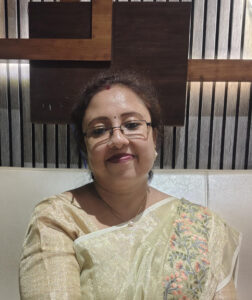
Atmaja learned early that the world expected a particular kind of woman. Her grandmother called it “the gentle arc”—a life that rose with ambition, bent toward care, and smoothed itself into a graceful decline of contentment. In college, while neighbours whispered about suitable matches and relatives folded advice into wedding wraps, Atmaja wrote manifestos in blue ink on the backs of discarded assignment sheets. She wanted a career that mattered, a name in letters that smelled faintly of press ink and late-night labour. She wanted simplicity at home: a small house, good food, a garden where a single frangipani tree could shade her evening reading. She wanted to own a life held by her own choices.
The world, as it often does, obliged in strange ways. After a hurried, sunlit romance—Rohit unclipped her stubbornness like a clasp, complimenting her laughter and the way she pronounced difficult verbs—she married. Their wedding photos looked like the pictures from magazines: Atmaja in a saree the colour of ripe mangoes, Rohit in a suit that made him look older and more substantial, both of them laughing at a private joke. She landed a job at a small but ambitious media house that was, for a while, exactly what she had imagined: tight deadlines, live wires of adrenaline, colleagues whose names she could call from memory, stories that altered the ways people thought about their city.
The daughter came three years later. Meera arrived with a soft, serious face—an infant compact with the solemnity of a monk. Motherhood, Atmaja discovered, enjoined her to a new grammar. There were milestones with dates and arcs; there were rows of photographs that everyone admired. “You’re brilliant at this,” Rohit would say, proud but offhand, when Atmaja juggled a pitch, a parent-teacher meeting, and Meera’s fever. Friends called her a wonder: she had an enviable job, a loving husband who taught mathematics to neighbourhood kids, and a daughter whose ribbons matched her better clothes.
From outside, Atmaja lived in a shining bubble. She was invited to speak at events—about work-life balance, “realities of the modern career woman”—and her face was the picture of composure in the local paper. People admired her recipes and the way her living room looked when she arranged flowers from the market. Her life, from the street view, had become what she had once drafted on blue-backed sheets and folded into her purse as a plan: ambition carved into social prestige, modest domesticity, love that steadied and refined.
Inside, the edges were less steady.
At night, after Meera slept and Rohit’s laptop made a soft metallic hum in their study, Atmaja lay awake in the darkness of her bedroom, counting other currencies. She counted the hours stolen from herself—the afternoons she had given to PTA meetings and the weekends spent organizing Rohit’s parents’ anniversary when her own manuscripts remained unfinished in a drawer. She counted the compliments she had received for being “so well-balanced” and the small, annoyed click of her teeth each time someone said it. She counted the way she had become a repository of approval, polished and pleasant, censored by a smile that never faltered.
The smile had become, in itself, a task.
A few years into Meera’s childhood, Atmaja found a new routine: the morning rush, the editorial meetings, the deadlines, the school runs, the grocery bargaining, the dinner with friends where she laughed on cue. There were awards—one for her investigative series that had altered a municipal policy—and there were parents who asked for advice. “How do you do it all?” they would ask, and Atmaja would blink, as if the question had a single, neat answer lodged within her chest. She would say, “No secret—just planning,” and they left satisfied, returning to their own gentle arcs.
Inside, the thing that gnawed was not the hours or even the infinite lists. It was the way her inner voice had been taught to occupy third place: husband’s career, daughter’s needs, public image. Her own desires, which had once been fierce and jagged like young glass, had been sanded into polite curves. There was a work-rough manuscript she had started in her twenties about a flood and a woman who refused to leave the riverbank; she read a paragraph now and then, the words whispering at the corners of a life that might be reclaimed.
On a humid April afternoon, when Meera was nine, and Rohit was buried in a lecture series for his promotion, Atmaja received a letter that altered the tilt of everything. It was from a small literary press in the neighbouring city that had run one of her early short pieces online. “We want your longer work,” the letter said—an invitation, an actual seed. For one fulsome minute in the kitchen, standing near the sink, hands in soap-scented water, Atmaja allowed herself a tiny, disobedient smile. Then the list of practicalities returned like tidewater: deadlines to meet at work, Meera’s tuition payments, the need to appear untroubled for everyone who saw her.
She told no one at first. She began to wake earlier, at dawn, the house still asleep and the sky a thin smear of blue, and type in the cool silence. Her fingers remembered the old cadence. There were mornings when the words poured, as if they had been waiting in queues along her ribs, impatient and hungry. She wrote about Meera’s small stubbornness in refusing to wear shoes, about Rohit’s laugh, about the flood that never visited her city but lingered in childhood memory. The manuscript grew like an underground river.
For months, she lived in two time zones: the daylight one where she attended meetings, smiled with appropriate pauses, checked Meera’s homework, stifled the sudden sharpness at an editor’s offhand, and then an underground dark where she wrote and revised, argued with herself about scenes she loved and scenes she discarded. She felt alive in that buried world in a way that made her daily life feel heavier, as if gravity had shifted.
The universe, again, negotiated. The manuscript was accepted with a modest advance. The press wanted her to come for readings; they wanted to put her on panels. The advance was small but symbolic—an acknowledgment that her imagined life could recede from private to public, that the woman who had once been a manifesto might become audible again.
When the book launched, the city loved her. People read and praised the tenderness and the quiet ferocity in her voice. She stood at the podiums and read passages about a woman who stayed to watch the flood, and audiences nodded as if recognizing the truth they had not known they shared. She was celebrated for being “so real” and “so brave” to write about the unglamorous, raw edges of domestic life. Again, the world courted her halo.
At home, the reactions were mixed. Rohit was proud, naturally, and sometimes he would hold her hand in the dark and say, “I knew you’d do this.” But his support had contours: he loved the parts of her that society applauded, celebrated the author who could be photographed with a neat stack of copies while he stood beside a cup of tea. He loved, as well, the wife who could ensure the smooth running of calendars and quieted Meera’s alarms on weekdays. When Atmaja asked, once, if they might hire a tutor so she could take a weekend away to write, Rohit’s face folded into practical worry. “We have to think about expenses and Meera’s schedule,” he said. “Also, you’ve always managed. Why change it now?”
Atmaja learned to swallow the sting of those conversations. She learned to choose which fights were worth starting—admiring herself for the battles she did not pick, and chastising herself for those left idle. She thought often of the gentle arc her grandmother had praised. Maybe the curving life was what she wanted after all: peace, and the quiet consumption of little honours. But the manuscript in her drawer hummed. The voice that had birthed it wanted more than quiet consumption; it wanted insistence.
Then, the small fissure widened. Meera grew into a child with opinions on everything—from the colour of her school bag to the weather’s moral obligations. At twelve, she learned to fold her own clothes but also to critique Atmaja’s essays on social media etiquette. Once, when Atmaja was tired and terse, Meera said, “Mama, you’re always smiling at people who don’t deserve it.” The sentence landed like a pebble thrown into the still water of her evening. It rippled deeper than reproach; it named truth. Atmaja could not remember the last time she had been allowed to show an unpolished mood in public.
It took only one more pebble. A colleague at the office, used to Atmaja’s placid professionalism, remarked in a meeting, suggesting she had “become domestic” and thus more reliable in office politics. The jab was careless; he meant it kindly, as a remark on her dependable nature. But something inside Atmaja, knotted and threaded and patient for years, unclasped. That night, she locked herself in the study and stared at herself in a mirror propped against the wall. She saw the woman who had once planned her life with manifestos, and the woman who had become a curated composite. Her smile looked like an artifact—placed there for viewing, not living.
She began small. She bought train tickets, secret ones, for a Saturday in a month when Rohit had to lead a conference. She told no one she was going. On the day she left, the city was washed in a clean blue. Meera kissed her forehead without complaint; there was trust in that brief benediction. Rohit kissed her too, and she wondered for an instant whether his lips knew the urgency gripping her. He did not ask where she would go. He assumed routine. The journey out of the city felt like stepping into a different grammar. On the train, the swing of her bag, the rustle of newspaper, the conductor’s chime—these were ordinary things she had once delighted in as a younger woman who had navigated first jobs and errant train timetables. She carried nothing but two notebooks, a pen, and a small packet of snacks. She had not planned this exactly; she had only planned enough to feel the possibility of not always being the smiling answer. She wanted to see if she could be other things without apology. She spent the weekend in a small coastal town where wind and tide were frank and unpretentious. In the mornings, she wrote in a café that smelled of coffee and lemon peel, and in the afternoons, she walked the shore, letting the sea name things she had not yet learned to say aloud. There was a freedom in anonymity; no one here expected her to be composed or performative. She wept for reasons that were not articulate: the ache of unspent hours, the sharp love for Meera that sometimes felt like a claim on her existence, the ache of small compromises piled into a barrier. Her tears surprised her—sudden, warm, and honest.
When she returned home, something had shifted with delicate force. She still cooked for the family, still attended the PTA meetings, still smiled in photographs. But the smile was now a conscious choice rather than an instinctive armour. Other changes were quieter but no less meaningful: she said no to an after-hours meeting without a sense of immediate guilt; she decided to hire a tutor for Meera with the modest advance from her book; she put a sign on her study door that read ‘Nothing but work; knock only if urgent’.
The ripple became a tide over time. Talk at the office about her “rebirth” as a writer was sometimes indulgent, sometimes approving. But the most significant change came in the domestic hours. Atmaja found ways to wedge time for writing into the smallest cracks. Meera, initially baffled, grew accustomed to her mother’s late-night tapping away on the keyboard. Sometimes Meera would climb into her lap and read, and Atmaja would let the child read aloud, watching the words being translated into a future they shared. Rohit, at first perplexed, adapted; their marriage refolded itself into new contours. They argued less about chores and more about values. He attended an early-morning recital where Atmaja read from her new work; he listened, then laughed softly when she mispronounced a word—an old, intimate sound that sounded like home.
But old patterns are stubborn. There were mornings when an invitation to speak at a prestigious conference would appear, and Atmaja would catch herself rehearsing not just what to say but how to appear—gracious, calm, in control. She would find her hand smoothing her speech as if she were touching a wound and pretending it was fine. The calculus of pleasing did not vanish overnight. People still loved the image she now partially resisted manufacturing. They still expected her to be a synecdoche of composure. Once, after a long day, she received a message from a woman she’d met at a reading—a single line: “How do you stay so happy all the time?” Atmaja read it and almost set the phone aside. Instead, at two in the morning, she typed back an answer that surprised her: “I don’t. I practice being honest about the unhappy parts.” The woman wrote back with gratitude and secrets. She was a teacher with two kids and a husband who worked nights. She felt guilty when she wanted to write. They exchanged messages for months, a small clandestine fellowship. It comforted Atmaja to speak with someone who did not need her to be an emblem but valued the raw stitches of struggle. Her confession—practice being honest—released more than it had intended. Admitting the presence of unhappiness made it less monstrous.
Year by year, the edges softened not into dullness but into a deliberate architecture of choices. Atmaja still bore responsibilities. She could not dismantle the structure of duties overnight; nor did she want to cast them off entirely. Instead, she learned the art of negotiation—with others and herself. She refused invitations when they drained rather than nourished. She asked for what she needed at home and at work. She started a small writing circle at the community library on Saturdays, where neighbourhood women and young men met to read and write together. They were not polished readers at first, but they were earnest, which was sometimes better. The change did not make her immune to doubt. There were afternoons when Meera would roll her eyes at a parental request, and Atmaja would feel the reflexive urge to reclaim former patience. There were days when the weight returned—a thin, viscous thing—especially when a review of her new book called it “a gentle memoir” and praised its “steady grace,” words that felt like praise and a slight erasure at once. “Gentle,” she wanted to say, “does not mean small.” Her goodness, she wanted to assert, could also be fierce. On a humid evening, when the frangipani outside their small garden shed petals like little moons, Meera came to her in the study with a school project tucked under her arm. “They’re asking us to write about our mothers,” Meera said. “Can I write what I think?”
“Of course,” Atmaja said.
Meera sat and wrote, longhand, her pencil scratching. When she read the paragraph aloud later, the house held still. “My mother is like a river,” Meera said. “She looks calm, but underneath, everything is moving. She loves me and my things, and she writes when I sleep. She also pries open jars when I can’t, and she gets angry sometimes and then apologizes with a chocolate.” Atmaja felt a thing in her chest—joy braided with a naive sorrow. Her daughter had named her truth. She went to the window and watched the city lights blink on like knowing eyes. The smile on her face was not a mask. It was a deliberate letter to herself, spelled carefully and repeatedly.
Atmaja came to understand that living a humble life does not preclude ambition, nor does ambition negate humility. Her ambitions altered in shape—they were not the grand, conquest-driven designs of her twenties but a more patient, stubborn persistence. She wanted to write, to keep writing, to teach others to find their words. She wanted to be present for Meera, but not defined only by that presence. She wanted to let her smile be one feature among many: a tender and chosen thing.
In the end, she realized the trouble had never been the responsibilities themselves. It had been the notion that she must hide the price she paid for them. The always-happy, perfect image was a currency she had exchanged too often for the pleasure of simplicity. Reclaiming the rest of herself meant confronting guilt, learning to ask, and sometimes failing and trying again.
Once, alone in the kitchen, Atmaja found the old blue-backed sheet with its manifesto curled in a cookbook. It had faded lines and passionate scrawl. She read the words that the younger self had written—bold, impatient, unclipped by domestic softness—and smiled without apology. She placed the paper on the mantle beside the frangipani photo and let it be what it had always been: one map among many. When she lectured students for the university class on contemporary narratives, she did not offer tidy answers. She spoke of compromises and choices and the way the arc of life can be both gentle and jagged. She told them she had not solved the great riddle of being but had learned a method—small resistances, honest admissions, and the courage to leave sometimes, even for a weekend, and return transformed. Atmaja lived within a constellation of loves and duties; she continued to be a mother and a partner, and a public woman. She also remained, stubbornly, an author of small rebellions. Her handwriting, once a manifesto, now became a series of deliberate acts—words scrawled between grocery lists, bold letters at the margins of a recipe, a sentence typed at night that refused to be kind.
The city, generous in its forgetfulness, continued to call her “so composed” and “so gentle.” She allowed them their labels. She had, quietly, learned how to be unafraid of the parts of herself that did not fit into neat phrases. She learned the economy of a true smile—how it was sometimes currency but more often a return on investment: the honest exchange of pain for presence, the careful offering of laughter that had teeth. Once, at a reading, she watched Meera in the front row, legs swinging, eyes bright and proud. Rohit sat beside her, holding her hand in a way that said we are both tired and holding. Atmaja read a passage that ended with a line about a woman standing in a doorway while a storm rearranged the horizon. When she finished, the applause washed over her like rain. She felt gratitude. But when the crowd asked for a question, Meera’s hand shot up. “Mama,” she said, “are you happy?”
Atmaja looked at Rohit, then at Meera, then at the faces in the dark. She thought of the old manifesto and the new acts, the nights of secret writing and the mornings of groceries. She thought of the times she cried, and the times she laughed until her stomach hurt. She chose not to craft a neat answer for the applause. She said, in a voice steady and true, “Happiness comes in fragments. Sometimes I have it. Sometimes I work to have it. Mostly, I am learning how to care for the parts of me that make it possible.” Meera smiled, satisfied. The crowd softened. In that moment, Atmaja felt an unremarkable, profound peace—one that did not erase the turbulence but honoured it. She realized that her life, with its arc and its bruises, its small victories and stubborn compromises, was not an equation to be balanced perfectly but a story to be tended, page by page.
She returned home that night and found her daughter’s drawings pinned to the refrigerator, a tea-smudged note from Rohit reminding her of an early-morning meeting, and the blue-backed manifesto resting on the mantel. She picked it up, smoothed it, and let the smile on her face be the thing it had finally become- honest, chosen, and wide enough to hold both the river and the shore.
*


 పెద్దన్న మారబత్తుల
 Chandana Alluru
 విశీ
విశీ
 సంజయ్ ఖాన్
 ముక్కామల చక్రధర్
 శ్రీరామ్ పుప్పాల
 మౌని
మౌని
Add comment