
 ఏ.కె. ప్రభాకర్
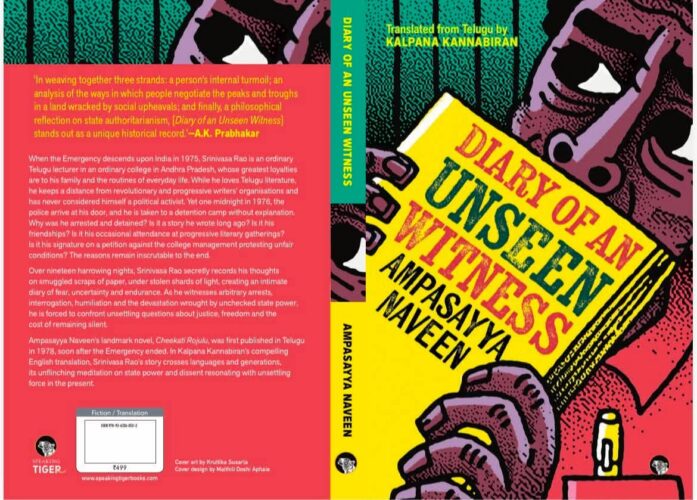
(The country marks fifty years since the declaration of Emergency. For nearly a year and a half, personal dictatorship held sway. Pens and brushes were put in chains. Freedom of the press was violated. Freedom of expression disappeared. In the name of national security, the prisons opened their jaws. Civil rights were put in peril. Even the courts fell silent. The state hunted political opponents without distinguishing between left and right. Intellectuals described those as dark days for democracy. Depicting the fearful atmosphere of that time, numerous writings and films later appeared across the country. Among them, the first creative work is Cheekati Rojulu written by Ampasayya Naveen. At a time when the excesses of those days are being repeated in many forms, that novel has been published in English under the title Diary of an Unseen Witness by Speaking Tiger Books. On this occasion, A. K. Prabhakar conducted a conversation with the book’s translator, Kalpana Kannabiran, for Saaranga.)
A K Prabhakar: Kalpana garu, this may well be the first novel you have translated from Telugu into English. While Naveen’s other works—written in the stream-of-consciousness technique and those that record seventy years of Telangana history—are otherwise well known, why did you feel you should translate specifically the novel ‘Cheekati Rojulu’?
Kalpana Kannabiran: Prabhakar garu, thank you for doing this interview. I will approach your question from the other end. My interest is in looking at creative writing that circulates around state violence, and the human predicament under authoritarianism. I have also looked at creative writing around the ‘corruption complex’ earlier. In looking at corruption in the literary imagination in India (in different languages) and its correlates, historically, I attempted to unravel its situated meanings, continuities and discontinuities over time and across regions and linguistic cultures. The ‘corruption complex’ in Indian literature congeals around the law: colonial law and its fossils in the postcolonial period for example, and the state in its embrace with dominant interests. My interest was in excavating radical critique in the fictional narration of corruption. I have elaborated on this to explain my interest in what I have called the ‘Emergency moment’.
I am not a student of literature – I come to literature through the lens of law and ‘jurisliteratures’ – judgments as literature for instance, drawing on the work of Peter Goodrich. The site of specific interest for me is the courtroom as an embodied space where words and their meanings have immediate and clear consequences for people, bodies, suffering and freedom. Alongside this, I have been interested in a deep engagement with the work my father did in developing an insurgent legal praxis and the ways in which he crafted an enunciation of the constitution, which importantly, drew on the performance of literatures of dissent in courtrooms. It is these intellectual and political trajectories that drew me to Naveen garu’s novel Cheekati Rojulu – in particular, the ordinariness, and the banality of state repression, and its devastating afterlives. Outside of the spectacular, or the heroic. Outside of ‘insurgent’ contexts. In other words my attraction to this work was very specific. To this text and the context it described. This is my first, and to date only, engagement with the work of Ampasayya Naveen garu.
Prabhakar: Telugu is not your mother tongue, is it? In the novel, some characters speak entirely in the Telangana language—and that too in a working-class rural dialect. What care did you take to translate the Telangana speech patterns so that they would reach an English reader?
Kalpana: To begin with, I belong to a species that cannot claim a mother tongue or a father tongue. I grew up in a peculiar situation arising from a combination of urban middle class convent education, and familial environments that were not focused on immersion in the vernacular. That has never been a deterrent, though. I have worked in and through translation in all the work I have done – across different languages. Every language I know has been learned and imbibed and absorbed as a ‘non-native speaker.’ Ethnographic immersion, radical empathy and understanding always guide me in my writing. I have schooled myself over decades in deep and intense listening and writing – to dive below the surface of what I hear or read, in order to comprehend better the experience being spoken about in vernaculars – much of it non-verbally. And I have heard Telugu in its various lilts and rhythms and dialects spoken over a lifetime, having lived an entire lifetime in Hyderabad and travelled widely across the Telugu states and worked with communities on questions around constitutionalism. My attempt in this translation – as in all the work I do – was to grasp the emotion (which is always culturally rooted in its articulation) as closely as I could and convey it in English – the language I think and write in. I approached this translation intuitively – driven by the belief that there is a raw, emotional, poignant story to be told and shared with a wider readership. In this, I was guided by my father who pointed me towards this book – ‘Ampasayya Naveen’s Cheekati Rojulu provides us with a graphic account of that time.’ I guess the motivation for undertaking this translation was the interweaving (in my mind) of the frames of literary storytelling and ethnographic storytelling.
Prabhakar: This book has been published by Speaking Tiger. What is their plan for translating any Telugu work into English? How is their interaction with translators? Please say a couple of words about their editing policy.
Kalpana: This is my first book with Speaking Tiger. They had published Khadeer Babu’s stories –That’s a Fire-Ant Right There: Tales from Kavali – just before Diary of an Unseen Witness. They work a lot with translation – fiction and non-fiction. And with new authors and authors unknown to English readers. I have never had a literary agent – neither for my academic publications nor for my trade publications. I have always just written directly to the publisher with my proposal or the draft manuscript. I liked the fact that they accepted direct submissions – it was something I was used to. Ravi Singh got back to me in a couple of months with a very positive response. And my editor Dyuti Roy was also very involved in the process – we talked about what worked and what didn’t – and actually did not have any disagreements, because both of us were open to dialogue/discussion. It was an incredibly smooth process.
Prabhakar: This is the first novel on the Emergency to appear in any Indian language. Naveen is also the first writer to describe that period as “dark days.” Later that phrase gained political currency across the country. Why did you change such a famous title? It has the effect of reducing the suffering experienced by the entire society to the torment of a single individual, doesn’t it?
Kalpana: This is an arguable point. I worked with ‘Dark Days’ and ‘Dark Times’ initially. But what captivated me about the novel was the act of ‘bearing witness’ – of seeing, of recording the truth, of discerning the complexity of carceral situations, of testifying to the deep oppressions of those times in particular and authoritarian times in general. We are used to reading about surveillance. Not so much about the muffled voices and silencing of acts of witnessing. The protagonist here is not a single individual, nor is the predicament his alone. He is rendering the ‘dark times’ legible for us all. For posterity. It is a warning – ‘Be warned! There are witnesses who will speak the truth in whatever way they can, at enormous personal cost.’ Cheekati Rojulu’s relevance for me travels far beyond the Emergency Moment. Also, sometimes a title that works in Telugu (or Tamil) may not work as well in English. I know of several instances where the English title is framed differently from the original so it loops in the English reader – although this was not my reason for choosing a different title. Ultimately, I guess the translator must weigh her words and decide – and there will be a range of different views on this.
Prabhakar: Did you consult the original author Naveen about this? What were your experiences regarding changes and additions in that process? At the time it was written the novel was a contemporary work, but fifty years later it has become period fiction. Did you consult other writings related to the Emergency in order to cross-check the fictional elements described in the novel against factual data?
Kalpana: I discussed the title with Naveen garu as well before taking a decision. I had two reviewers of the draft translation – both of whom agreed on the question of a changed title that would point to the specificity of the text. I finally decided on this title, because for me, it captures the essence of this work. Naveen garu read my translation as it progressed. Where I wanted clarification, I discussed it with him. Like I said I see this as part of my larger engagement with Emergency literatures. It is a work of fiction that speaks about experiences of a particular time in Indian history – I did not feel the need for any ‘fact-checking’. I see it as a work of Indian realist fiction. The characters and context are not distant, nor unreal, nor do they speak strange tongues. As Bakhtin said, ‘the boundaries between fiction and nonfiction…are not laid up in heaven’. I return here to the point I began with. How might we excavate radical critique in the fictional narration of Emergency? Is Srinivasa Rao an insurgent narrator, the diary an insurgent script?
I use law and literature as my point of departure overall — the stunning intersections between the ‘literary imagination’ and the ‘legal imagination’. During the Emergency, as now 50 years later, the criminalization of resistance – at every level – formed a major preoccupation. Did this criminalization in law deter the insurgent imagination of resistance or indeed its practice? What were the fields of this insurgent imagination? While case archives tell a valuable story, the literary archive opens this out for us in distinct ways. There is a unique place Cheekati Rojulu occupies in the literary archive for me. At the heart of each story is an idea of justice and a deep, smouldering anger over the betrayal of the aspirations of ordinary people. In their travels we see the ordinary everyday aspirations of ordinary people being disappeared by the everyday state and its musclemen, we hear them parodying the dehumanising realities that ravage them, that they resist every day in small, intimate ways. Justice resides in the here and now, not a finished project, not the preserve of authority, but in speech-acts of common, everyday people. The diary is one such intimate speech-act of an unseen witness.
Prabhakar: What do you think about the relevance of this novel’s translation today?
Kalpana: Translating Cheekati Rojulu for me has been part of a memory project that revisits the devastation of authoritarian rule and helps us comprehend and map the tenacious genealogies of civil liberties and constitutionalism in India and abroad well into the present-futures. As we have recently seen with the massive youth resistance against authoritarianism and state arbitrariness/ repression. The spirit of this resistance is reminiscent of the anti-Emergency resistance in spirit – the methods, modalities and language of resistance is very different, as it should be. We are witnessing a different generational shift in the practice of constitutional insurgency. From naxals (and their sympathizers) to dimagi naxal. From Cheekati Rojulu (who is not a naxal?) to the youth resistance today (who is not a dimagi naxal?) Speech is the armour and the shield and weapon of resistance that is cascading and unstoppable in the present, as it was in the 1970s, when it brought down a government. The connections are important.
Prabhakar: How did your experience of translation feel throughout this entire process?
Kalpana: It was difficult to begin to translate Cheekati Rojulu. I picked it up several times and put it down after reading a few pages over four years. But I kept picking it up again. Both because my father had specifically mentioned it and I wanted to understand why, and because the novel itself kept beckoning me. Initially I was impatient – the ways in which time comes to a grinding halt was very disconcerting. And yet, as I kept picking it up again and again, I realised that the brakes on time were not brakes but the sense of time in a camp, the tempo of ‘life’. There was another reason I kept returning to it. I knew that the line between fact and fiction was thin (again Bakhtin comes to mind) – I had seen how thin the line was, when I was in my teens. Torture, disappearances, illegal arrests were not unfamiliar and I knew people who had experienced that life, and resisted or walked away from it – both. E. Bhikshapathi (1947-2020) a torture survivor who bore witness of the Giraipalli encounter before the Bhargava Commission stayed in our home during the proceedings. Four people had been shot dead in his presence. And as adolescents we had heard people talk to him and about what he had seen. I never saw Bhikshapathi after that, but never forgot him. To this day he remains vivid in my memory – I remember his voice when he spoke in monosyllables, the way he looked and moved soundlessly around the house…
I felt the story of Srinivasa Rao had to be re-told in English – he is not your typical hero, he berates himself for his own cowardice and fear, and yet he records what he sees without turning away…scared, feverish, nauseated, but persistent. I finally stayed with the novel and finished the translation in one sitting. As I progressed with the translation, the question that kept hanging over me was about its relevance in our time – this had to do with the work I was doing over the past ten years.
Several people asked me if this was an opportune time to criticise the Congress and speak of the Emergency of the 1970s. This is a text about the profound harms visited upon people by the authoritarian state in the 1970s. The Congress was in power then. That is a fact. We live in a state of ‘Undeclared Emergency’ now, and see state impunity and delegated violence by dominant groups on a scale unknown before, with every institutional pillar of democracy capitulating to the Executive. It is the BJP at the helm now. That is a fact. The playbook and parallels are unmistakable. The tale is not about the Congress. It is about a form of government that authorizes violence and rules through the politics of maiming. In this, as I have written elsewhere over the past ten years, the BJP’s record is unparalleled. The continuities and discontinuities kept returning to me while I was translating this novel, aware of its aftermaths, since the novel itself ends during the Emergency, and leaves you bereft, as it left Srinivasa Rao. So we plunge directly from the darkness of Emergency into the pitchdark world of Hindutva majoritarianism.
Are these two moments connected? Should it matter? And I realised, it does matter. The politics of maiming and illegal arrests, detentions, incarceration, custodial death, collective violence and state impunity have returned with unparalleled ferocity and are being resisted with renewed force. Nikhileshwar garu’s poem ‘Bhayam’ which he recited in court in the 1970s, is back to the centre of our political discourse today in the voices of the conscientious resisters – in prison, and in the many Jantar Mantars that cascade across the country. So Cheekati Rojulu spins back to relevance in the times of Hindutva rule – how might we bear witness? There was a novel written fifty years ago that dwelt on this possibility…
*


 పెద్దన్న మారబత్తుల
 Chandana Alluru
 విశీ
విశీ
 సంజయ్ ఖాన్
 ముక్కామల చక్రధర్
 శ్రీరామ్ పుప్పాల
 మౌని
మౌని
Add comment