
 Sarbani Chakravarti
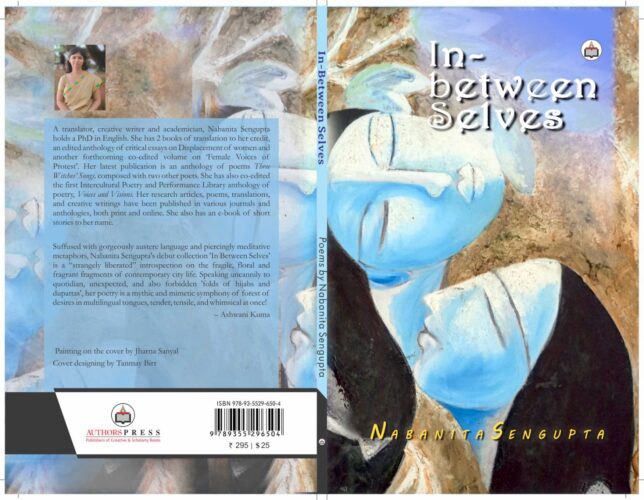
Nabanita Sengupta’s In-between Selves explores diverse themes spanning a wide spectrum of human emotions. The gamut of experiences that shape individuals and their sensibilities is expressed through different creative forms; for Sengupta, it is her pen that portrays diverse landscapes of sensory perception rooted in memory. It is here that the poems cease to be merely personal and become a repository of our collective memory—at once deeply intimate and universal.
The opening poem of the collection, ‘Devi’, captures both the quintessential spirit of Durga Puja and some fundamental social concerns. Sengupta juxtaposes the ‘psychedelic lights’ and joyful celebrations with the ‘agonized screams’ of women who are forced to conceal their own ‘multiple avatars’ in order to conform to social norms. She masterfully highlights the irony of a society in which the Divine Mother is revered, yet women are subjected to ‘checks and balances’, while the five days of festivities offer only a brief respite and a ‘fresh lease of being alive’.
In ‘The Seasonal Planter’, Sengupta explores the ‘in-between’ nature of modern psyche, navigating the friction between multiple personas that often sit ill at ease with each other like mismatched patches on a quilt. The poem functions as a metaphor for the creative process. Sengupta describes herself as a ‘whimsical planter’ who sows words according to the season of her heart—whether it be ‘full of happiness’, ‘mad rage’, ‘mellowed brimming nostalgia’, or ‘darker clouds of depression’. The imagery evoked by the simile ‘the words sputter like the choked mouth of an old scooter’s carburettor’ provides a gritty, mundane, real-life perspective, making the abstract process of creativity more relatable to readers.
Sengupta reiterates the maxim, “The pen is mightier than the sword,” through her poem ‘War of Words’. She implores poets to write only when ‘words bleed’. She contrasts the futile exchanges of sterile corporate boardrooms with the raw, visceral power of language, which serves as ‘ammunition’ for the scared and the oppressed. The poem is a compelling call for artistic integrity in a world saturated with superficial chatter.
Sengupta does not remain confined to merely inspiring poets to make poetry a vehicle for advocating the rights of the disadvantaged and the marginalized. In her poem ‘Pride’, she takes a decisive step further by becoming the voice of the ‘fight for a space for our rainbow dreams’. The poem presents a sharp critique of gender and identity through historical and mythological lenses. Sengupta invokes the figures of Brihannala and Shikhandi from the Mahabharata to expose the ‘quagmire of insolent patriarchy’, focusing on the systemic exclusion of those who do not conform to traditional gender roles and identities.
 The 41 poems in the collection are eclectic in their themes, making it impossible to weave them together through a single unifying perspective. Some poems belong to the tradition of eco-poetry, addressing the global concern of environmental degradation. Others draw an analogy between a parched soul awaiting raindrops and a drought-stricken landscape.
In ‘Rupnarayan Tales’, Sengupta adopts a meditative tone and presents the river as a site of liberation. In ‘A Night of Wait’, she explores the universal human experience of fragility. Elsewhere, she searches for a ‘sense of self’ amid a plethora of ‘selves’. In ‘Harlequin Soul’, she celebrates linguistic diversity through the portrayal of a multilingual self.
Despite the diversity of themes, Sengupta displays a remarkable ability to elevate the mundane into symbols of deeper emotional and existential states. This enables her to make even her more abstract philosophical inquiries accessible to the general reader.
In-between Selves invites readers into a liminal space where the personal, social, political and ecological collide. Nabanita Sengupta navigates the fractured landscape of the modern psyche with the precision of a cartographer and the insight of a philosopher. Rooted in profound empathy and understanding, In-between Selves is a courageous exploration of the complexities, contradictions and fragmented identities that define contemporary existence.
*


 పెద్దన్న మారబత్తుల
 విశీ
విశీ
 సంజయ్ ఖాన్
 ముక్కామల చక్రధర్
 శ్రీరామ్ పుప్పాల
 మౌని
మౌని
 శ్రీనివాస మూర్తి
Add comment