
 Mahua Sen
Some memories do not fade, they arrive unannounced, bright as pink, green and yellow gulaal against the blue sky. Such memories carry us back to childhood, to the days when Holi was more than a festival, when it was an emotion. When the festival arrived with happy shrieks of mock outrage, the conspiratorial hush-hush of friends and cousins plotting their next playful attack. Elders would chide us for all the ruckus, even as they secretly planned their own ambush. It was a festival when the world felt closer, softer, kinder, and spectacularly happy and bright, at least for a few precious hours.
Since childhood I believed, Holi was more than a festival of colours, or a celebration of good over evil. It was also a celebration of connection, cooperation, and commemoration. It was the one time of year when laughter travelled faster than colour, and every doorway felt open. I vividly remember our ancestral home brimming with the raw ingredients for Holi sweets. The preparations began at least ten days in advance. The kitchen shelves would overflow with flour, khoya, dry fruits, jaggery, and spices, uplifting promises of what was to come. There were the customary delights, Mapula made fresh on the morning of Holi, bowls of Ghughni simmering gently, and soft Dahi- Vadas soaking in spiced yogurt.
In those days, our home had three separate kitchens. One for non-vegetarian meals, one strictly for vegetarian cooking, and another for the house helps. Any festive or celebratory food was always prepared in the vegetarian kitchen, as if ritual and purity were inseparable companions. Looking back, I realize it was not just about the sweets or the colours. It was about the anticipation. The ten days of collective fun, labour, ritualistic recipes, and the fragrance of ghee lingering in the air. Holi was not confined to a single day, it unfolded slowly, filling the house long before the first splash of colour touched our skin.
Just two days before Holi, we would be taken to the local shop to buy pichkaris — the ritual we awaited with all our hearts. Of all the preparations, this felt the most personal, the most thrilling. What enchanted me about pichkaris was their imagination. They were never just simple water squirters.
They came shaped like school bags, bright plastic guns, water bottles, dragons, and our favourite cartoon characters. Some were neon, some metallic, some transparent with glitter floating inside. They were less about colour and more about possibility, about choosing who you wanted to be that Holi. In that small act of selection, standing before rows of vibrant shapes, I felt a reassuring ownership of the festival. Holi, at least for a child, began not with the colours, but with the freedom to choose. It wasn’t the thought of spraying colours that fascinated me. I was, in fact, afraid of getting drenched. Holi, usually falling in March, carried a lingering chill in our village in Bihar. Getting soaked meant shivering beneath the pale sun, teeth chattering as we tried not to cry, waiting for Ma to appear with dry clothes and a warm towel. The cold clung to us stubbornly and yet, the moment we were wrapped in the warmth of dry clothes, we would dash back outside again, as if nothing had happened.
During the day, all my uncles and buas would begin playing Holi at home. A joint family has its own thrilling charm. Noise, laughter, mock arguments, sudden attacks of colour from behind pillars illuminated the milieu. Yet, the moment I saw my Ma being smeared with bright colours, I would burst into tears. I would shout in desperate protest, “Please, amar maa ke rong lagio na tomra!” (Please don’t put colour on my Ma!)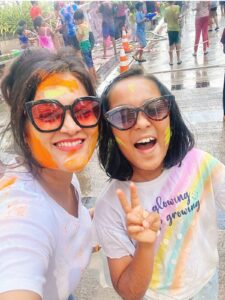
My uncles and buas still tease me about it to this day.
After the riot of colours at home, we would step out into the neighbourhood, especially to the house of Deepu Dadu and Moni Dida, whom my elder sister and I adored. Their tiny, cozy home held a warmth that far exceeded its size. Many afternoons were spent there, wrapped in a kind of uncomplicated affection that only childhood recognizes fully. Moni Dida was an indispensable part of our everyday life. She would often visit our house to help cut vegetables, and every evening, almost ritualistically, she would braid my sister’s and my hair into what we called Kola Benuni( a traditional style braids ). I was too restless to sit still, so she would distract me with stories — folk tales, village legends, stories of Shakchunni and Petni (Female ghost from Bengali folklores), perhaps some she invented on the spot. But those evenings remain among my most cherished childhood memories. Sitting in our aangan under a wide, star-studded sky, sipping milk, listening to Moni Dida’s voice rise and fall while her gentle fingers worked through my hair.
Growing up happens too quickly. We move cities, chase ambitions, and loosen our hold on the hands that once steadied us. I was studying in Delhi when I heard of Moni Dida’s passing. I remember crying not just from grief, but from regret that I could have spent more time with her, written her letters, kept in touch. Phones were not common then, and yet excuses feel hollow in hindsight. Such regrets seem almost quintessential to loss. Each goodbye wrapped in the ache of “I wish I had.”
Coming back to Holi, after visiting their home and a few more family friends in the neighbourhood, we would return for a hot-water bath. The kind that thawed frozen fingers and pink noses. And then came my favourite part, the afternoon performances when men masquerading as women would dance on traditional folk songs. Many such groups would arrive singing and dancing, their voices ringing out, “Rama khele Holi ho, Shyama khele Holi ho…” Even now, decades later, those melodies echo somewhere deep inside me. My siblings and I would receive coins and small change from our grandmother to offer them. One troupe would leave, and we would rush to the window, peeking out in anticipation of the next. This would continue until evening, when we were asked to bathe again and change into fresh clothes because evening meant reverence. With gulaal in our hands, we would touch the feet of elders and seek their blessings. It began at home and extended to every house in the neighbourhood. The air would be thick with the fragrance of gur, ghee, and festive delicacies. And at our own home, guests would begin pouring in from early evening until late into the night. Laughter, footsteps, greetings, plates being refilled, doors never quite closing. This is how I remember Holi.
When I think of those days, I ache to return, not just to the festival, but to the people, some of whom I’ve lost to the jaws of time. I ache to return to the voices, the fun and frolics, the unguarded joy of it all. The days may have passed, but they live on in the precious casket of memory. I can still smell the sweets, taste the Malpua, breathe in that Holi air. As Holi, in those years, felt like love that was loud, colourful, fleeting, yet eternal.
As Holi approaches this year, let us play with colours, not just for the joy of the festival, but to promise to make each other’s lives brighter and more vibrant. Let us take a vow to lift one another, as Robert Ingersoll said, “We rise by lifting others.”
Let us make some memories to be cherished forever.
Wishing everyone a very Happy Holi!
*


 పెద్దన్న
 పసునూరి రవీందర్
 గుడిపల్లి నిరంజన్
 వంశీ కృష్ణ
 పొట్లపల్లి శ్రీనివాసరావు
 కృష్ణుడు
 సురేశ్ కొలిచాల


Add comment