
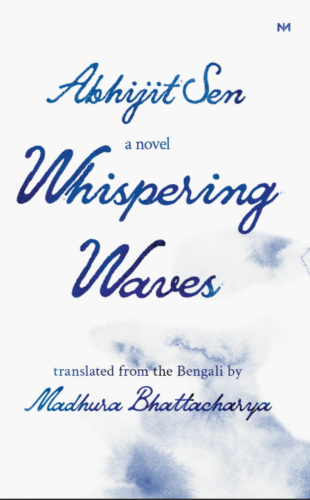
 Rajasi Kundu
 “Oh, that pretini hasn’t left you yet?” Alas! Some waves, winds and musings, perhaps remain with us. They, in the forms of beings of the netherworld or living characters from our past, cannot entirely leave us. They exist in the liminal shadows of presence and absence, or the infinite boundaries of belongingness and the lack of it.
Whispering Waves understands haunting not merely as a supernatural phenomenon. It exists as a continued memory of historical and gendered violence within the present, where Madhura Bhattacharya’s translation extends this politics of memory into English by retaining the Bengali cultural textures of the original. Abhijit Sen’s novel, published by Moving Words, an imprint of Antonym Collections, sits at this very juncture of the dilemma: whether the past can ever become a distant memory when the land in which it is located has itself been rendered “foreign” by Partition. Aditi, the character around whom the novel revolves, leaves her Borobari in Keya, a mansion, now situated in another country, Bangladesh. She comes to Kolkata with her refugee family. However, alongside the mobility centred around partition, there is yet another turbulent wave that keeps stirring her hollow from within, the death of her elder sister Sudipta.
Through this narrative that constructs itself as a memory novel, Sen explicitly weaves a tale where one’s past haunts their present as well as the present haunts for a familiar tangible presence. This becomes more visible at the beginning of the novel itself, where Aditi, after being taken out of an operation theatre, high on the dosage of anesthesia wants to recall the exact number of Petnis in their house in Keya, their ancestral village in Bangladesh. One might wonder whether it can be the effect of medication or hospitalization, but to the implied reader, this can be equivalent to a quest where a person constantly tries to configure the pieces of a puzzle, long lost is the muddy alleys of past, throughout the present. The author continually navigates the novel through a range of social concerns, from the trauma of Partition to women’s loneliness within failed marriages.
These concerns are only part of the novel’s larger socio-economic canvas. The novel draws attention not only to the work of NGOs supporting women who have been trafficked, but also gives the readers a peep into the other side of the story: the judiciary and law-making institutions, which often become bodies of opaque rules, procedures, and bureaucratic constraints. Rather than ensuring rehabilitation and security, these structures can make it exceedingly difficult for women to rebuild their lives and live peacefully after they return home. This would bring the implied reader to some more Pretinis, or haunting from the past. Can one really return to their “original” homeland? Does a home continue to be the “home” when one’s life is turned upside down through near one’s death, harassment, trafficking? This leads the readers to the question of belonging and un-belonging and of hope, of darkness and the courage to drift towards the shore, nonchalant to those waves that “whisper”.
The translation by Madhura Bhattacharya appropriately complements the text in Bengali as its English counterpart. Bhattacharya’s articulation through her translated work navigates like a fine boat in between Whispering Waves, and the most important part, balancing the rapids around fidelity to the source text as well as the readability. The use of original Bengali words like bhuinmali, bighas, or even Mashi (for Jolushi Masi) retains the original essence of the terms and their societal position and endearment, based on their context. This act of retention of original words, is in fact a powerful politics on the part of the translator and as a novel that is based on cultural memory, affections and traumas regarding the past, the attempt is indeed praiseworthy. Whispering Waves ultimately suggests that one cannot return to their past because those conditions that made it home have been altered. Yet neither can it be abandoned. Like the pretinis that haunt Aditi’s memory, histories of Partition, loss and violence continue to inhabit the present. In this sense, the novel’s whispered waves are not merely calls from a vanished past; they are reminders that belongingness is itself an unfinished negotiation.
Bio note- Rajasi Kundu has completed her graduation and post graduation from the department of Comparative Literature, Jadavpur University. She is a certified translator from CENTIL, Jadavpur University which made her more interested towards how translations function, what affects the fluidity of the text. She is most passionate about her collections of poems that she tries to weave with words and unnemerable experiences of the ordinary, which makes them memorable
Whispering Waves by Abhijit Sen (Novel) Translated from the Bengali by Madhura Bhattacharya, Moving Words Imprint published by The Antonym Collections
Synopsis: Aditi has had to leave her ancestral mansion, “the Borobari,” in the village of Keya, Bangladesh, and move to Kolkata with her family. Growing up in a refugee family, she has built a career and found a place to call home. However, neither her career nor her sense of home flourishes, partly because of the hardships she observes in society and partly because she is haunted by memories of Keya and her older sister, Sudipta, whose lifeless body was once found in the village among the whispering waves.
In Whispering Waves, a novel by Abhijit Sen, the characters have settled into their new lives, but their abandoned homeland across the border continues to call to them—the only “home” they long to return to forever.
Aditi leaves her ancestral mansion, the Borobari in Keya, Bangladesh, and moves to Kolkata with her refugee family. She builds a career and a life, yet neither feels complete. The hardships around her and the haunting memory of her sister Sudipta, found lifeless by the whispering waves of their village, refuse to let her rest.
In Whispering Waves, Abhijit Sen traces lives rebuilt across borders, where the past lingers and the lost homeland remains the only home the heart truly longs for.
https://antonymcollection.com/product/whispering-waves-by-abhijit-sen/
About the Author
 Abhijit Sen was born on January 28, 1945, in Keora, a village in the Barishal district of present-day Bangladesh. In the early 1950s, his family relocated to Kolkata, where he began schooling. His educational journey took him to move between Kolkata, Jhargram, and Purulia before returning to Kolkata. Despite the disruptions, he completed his high school and parts of his college education during this period.
While working for a general insurance company in Kolkata, Sen pursued higher education, earning Bachelor’s and master’s degrees in history. His work required extensive travel across various mufassil towns and villages in Bengal, an experience that profoundly influenced his literary works, grounding them in the soil and history of Bengal.
In 1969, Sen made the life-altering decision to join the revolutionary Naxal movement. This choice led him to sacrifice his job, family life, and permanent residence in Kolkata. He later spent several years in Malda, in northern West Bengal, before recently returning to Kolkata.
Sen’s first novel, Rohu-Chandaler Haar, was published in 1985 and later translated into English as Magic Bones in 1992, a collaborative publication by Abhinav Publications (Delhi) and Facet Books International (New York). The novel earned him the prestigious Bankimchandra Memorial Award in 1992. Additionally, he received the Saratchandra Memorial Award from the University of Calcutta in 2005.
Most of the characters in Sen’s stories are drawn from his rich and varied life experiences, especially those during his travels through rural Bengal. His writings reflect a profound connection to the land and its history, resonating with authenticity and a sense of rootedness.
About the Translator
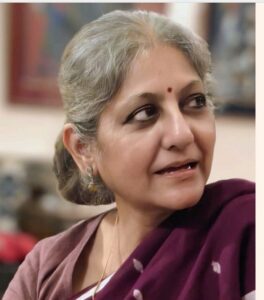 For most of her professional life, Madhura Bhattacharya has been a teacher and an academic administrator at a school and welfare organization in Kolkata. Madhura’s journey in literary translation began after she completed a certification program in the Department of Comparative Literature at Jadavpur University. Since then, she has been actively involved in various translation projects. Her collaborative spirit is evident in her work with other passionate translators, which has led to the formation of Translation & Beyond. This group is currently working on a project to translate a hundred African poems from English to Bengali, a testament to the power of collaboration in the literary field. She also participated in a translation workshop organized by The Antonym Collections, under the mentorship of V. Ramaswamy, to translate Abhijit Sen’s short stories. She is translating a biographical novel by Rupa Chakraborty from English to Bengali.
*


 పెద్దన్న మారబత్తుల
 విశీ
విశీ
 సంజయ్ ఖాన్
 ముక్కామల చక్రధర్
 శ్రీరామ్ పుప్పాల
 మౌని
మౌని
 శ్రీనివాస మూర్తి
Add comment