
 Lopamudra Banerjee
Satadeepa Gupta was born to parents Susanta and Nupur in a traditional Bengali family in Kolkata. She studied Biochemistry and did PhD (Science) from Calcutta University. From an early age she was trained in Rabindra Sangeet vocals and completed her Gitabharati degree from Gitabitan music school in Kolkata. She got married to Srikumar Mallick, with whom she later migrated to UK where she has served the NHS as a Scientist in Pathology Services for over 16 years. Having lived over 20 years away from home, she is deeply rooted to her culture and is dedicated to music. She started to get trained in Indian Classical Music later in life. She performs regularly and has collaborative work with other groups of singers and dancers and believes her religion is Indian music. She is a music teacher and also takes interest in drama and elocution. Her family has a home production series of drama and has also performed drama in England at the national level. Her grandmother Ashapurna Debi, one of the doyennes of Bengali literature in India, had the greatest impact on the philosophy of her life.
My interaction with Satadeepa Gupta started after the demise of her mother, Dr. Nupur Gupta whom I had the honour to know during the days of working on the English translation of Ashapurna Debi’s ‘Bakul Katha’, the last part of her award-winning trilogy novels. Thereafter, I have worked on another English translation of Ashapurna’s work, and our bond has grown stronger over the years, albeit virtually, till now. In this candid conversation with Satadeepa Gupta, I had the opportunity to talk to her about the rich legacy of her grandmother which shaped her life, as well as her own academic and artistic journey.
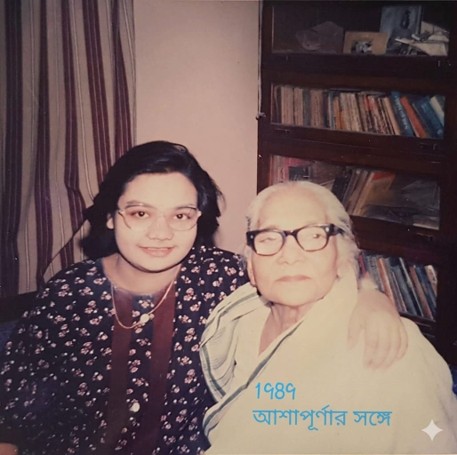 [Satadeepa Gupta Mallik with her illustrious grandmother Ashapurna at their Kolkata home]
Lopa Banerjee: Welcome, Satadeepa di, to this series of interviews on the changemakers of society. When I look at your life and your pedigree, you are born in an illustrious literary family in Kolkata, India, where you grew up in the gracious presence of your paternal grandmother, Ashapurna Debi, who was considered the doyenne of Bengali literature in the post-independence era, and also your mother Dr. Nupur Gupta, who has a distinct academic, literary identity of her own, being a professor of English, a poet and creative writer. What were your earliest memories of these two persons in your life and how did they shape your persona?
Satadeepa Gupta Mallik: Lopa, thank you for this question as I get an opportunity to share my innermost thoughts about my persona. As you know our persona is often heavily influenced by the people closest to us. We learn how to speak, what is acceptable, how to react to situations, and even how to think about ourselves from parents, grandparents, and others.
As a child, I was a blend of the strong female figures including my grandmother and mother, who had huge influence on me. I would admire my Ma’s analytical mind and nurturing nature. On the other hand, I was strongly influenced by Ashapurna’s spiritual aptitude and bold determination. As a child, I was visualized more as Ashapurna Debi’s youngest granddaughter than myself. That made me a bit shy to open up before others including relatives. At school, I was her granddaughter first and then what ‘I’ really was. This was not easy though. I did feel confused at times. Some of my friends thought I was slightly snobbish, which I was absolutely not.
Ashapurna and Ma belonged to different generations and as I grew older, my patterns of thinking, feeling and behaving naturally changed. It took me a long time to build up my own persona, overcoming my shyness. However, it gives me lot of pleasure when i meet someone new in UK who is acquainted with Ashapurna’s works, as they feel amazed to meet the granddaughter. They express their joy as if they have met the author herself!
I can sense that my natural temperament is more like Ashapurna than Ma. Although I am not an emotional person like Ma, but I do have a research-oriented mind like her. But whatever I am now has been possible through their blessings and my good intentions.
Lopa: Your grandmother Ashapurna Debi was actively involved in literary writing, surrounded by Bengal’s literary luminaries and the giant publishing houses of Kolkata, and you have seen her writing those award-winning novels, stories etc. when she was in her prime, while you were growing up in the same household. How did those heydays of your grandmother inspire your growing up years? Did she shape your literary sensibilities or reading habits in some way since those days?
Satadeepa: My literary interests were influenced more by Ma than by Ashapurna. I have read far more English literature than Bengali literature, although I used to read the famous magazines, ‘Suktara’ and ‘Anandamela’ regularly. Habits such as reading before going to bed and exploring subjects in depth are gifts that I inherited from my mother. I have not read all of Ashapurna’s mammoth work as I don’t think it’s possible by anyone. But I have read her magnum opus ‘Pratham Pratishruti’, ‘Subarnalata’ and ‘Bakul Katha’ and lot of other stories.
Lopa: Kolkata of the 1980’s and 1990’s was at the cusp of immense transformation, in which the feminist consciousness played a pivotal role, which also characterizes Ashapurna’s classic literary works, including the award-winning ‘Satyabati Trilogy’. As Simone De Beauvoir, the iconic twentieth century feminist, socialist intellectual had once famously quoted: “For a woman, there is no other way out than to work for her liberation. This liberation can only be a collective one.” Half-way across the world, Ashapurna was living in a sheltered domestic world, far away from this western ideology of feminism. Yet, looking at her journey, a girl who was denied the basic human right to study in school like the boys in her family, yet who was steadfast in her commitment to challenging the status quo and advocating for gender equality through her stories, and later going so far as to receiving the Padma Shri Award from the Indian government, didn’t this message of liberation resonate with her as well?
Satadeepa: This is my best-loved question in this interview. Not just because this allows me to say that two different feminist authors born in just a year’s difference, had the similar view towards women’s oppression and how to overcome it, but because the two writers did not hear about each other, yet voiced very similar philosophies about women’s liberation.
I would start with your quote: “For a woman, there is no other way out than to work for her liberation’, which you have taken from her book ‘The Second Sex’. I wish to add another quote from the same book: ‘One is not born, but rather becomes, a woman’ and I think they’re connected ideas. Beauvoir argues that woman” is not simply a biological destiny but a social condition shaped by expectations, institutions, and power structures. In the second quote it is clear that femininity is a produce of cultural environment as well.
The first quote is often interpreted as foundational to modern feminist theory and later ideas about gender as socially constructed. The second is more explicitly political: Beauvoir insists that emancipation depends on women acting to change their conditions materially and socially rather than accepting it passively. It establishes her argument that gender is a societal construct rather than a biological destiny, meaning that femininity is learned and shaped by culture.
Like Beauvoir, Ashapurna Devi believed women are shaped by social conditioning rather than biology alone. But where Beauvoir theorized “becoming woman” philosophically, Ashapurna Devi dramatized that process inside Bengali households and kinship structures. To compare them, we could say, Beauvoir asks: How is woman constructed philosophically and socially? Ashapurna asks: How does that construction operate daily inside the family? Ashapurna feminism was rooted less in abstract theory and more in the lived realities of middle-class Bengali women trapped within domestic patriarchy. Unlike Simone de Beauvoir, who wrote philosophically about gender and freedom, Ashapurna explored oppression through everyday family life, customs, marriage, motherhood, silence, and social conditioning.
I would take this opportunity to discuss Ashapurna’s feminist ideas in details.
Through her writings, her feminism can be understood through several key ideas which she herself had faced and came out victorious. Picking them up one by one will demonstrate how she resonated as well. In her famous trilogy ‘Pratham Pratishruti’, ‘Subarnalata’ and ‘Bakul Katha’, she portrays the domestic space as a site of oppression. This was a system of control where women were denied education, mobility, desire, and individuality. Not always through violence, but through “normal” social expectations. These novels trace generations of women struggling against patriarchy across changing historical periods.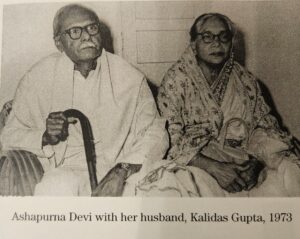
Ashapurna, who came from a family which did not support education for girls, believed that the only way of transformation and liberation for women was education. She realized that Women’s lack of literacy kept them dependent. This is reflected in her protagonists who are seen often hungry for reading, self-expression, and awareness. Ashapurna, was a big critique of internalized patriarchy. In her works, a major feature to observe is that women themselves often reproduce oppressive norms. Mothers-in-law, elder women, and even mothers enforce patriarchal rules. This makes oppression social and generational, not merely “men versus women.” Her heroines show quiet resistance rather than dramatic rebellion.
Resistance appears through small acts: They are seen questioning rituals, refusing submission, seeking education, asserting moral independence and nurturing selfhood. They are not revolutionaries in the conventional sense but look for intellectual freedom through small acts. This makes her feminism deeply tied to everyday life in Bengal.
Ashapurna’s feminism emerged from colonial and postcolonial Bengali society. In her stories, she addressed child marriage, restrictions on widows, domestic confinement, unequal education, expectation of sacrifice from women. Hence, we notice her addressing problems specific to history and cultures of Bengal as well.
So her feminism differs from Western existential feminism, though there are parallels with Beauvoir’s idea that femininity is socially produced.
Lopa: Apart from your illustrious grandmother whom we all know about, now let us know a bit about the men in your family too. I have read about your paternal grandfather, Ashapurna’s husband Kalidas Gupta in a few published articles and got to know that he was a staunch supporter and champion for the causes Ashapurna stood for—articulating women’s rights in the society through her writing. How do you remember the journey of your grandfather who was also instrumental in making Ashapurna? Also, can you share a bit about your father and other men in your family whose stories are worth sharing?
Satadeepa: The men in our family—my grandfather and my father—played a significant role in shaping Ashapurna’s literary career. In one word, their support was exemplary. Ashapurna’s brilliance was impossible to overlook, and both men recognized and nurtured her talent with immense dedication. But it was not only giving support from one side, it was a partnership of give and take.
My grandfather came from a very humble background, and Ashapurna’s arrival in his life transformed the entire course of his life. Born and brought up in Kolkata, Ashapurna was married into a village in Krishnanagar, where her literary hunger was unlikely to be fulfilled. Realizing this, she took the remarkable step of relocating her in-laws—including her mother-in-law and brother-in-law—to Kolkata. This move opened up better professional opportunities for my grandfather and his brother.
This decision itself reflects Ashapurna’s selflessness. She did not think only of her own aspirations, but of the well-being and progress of the entire family. Her vision and generosity deepened my grandfather’s admiration and trust in her, and in turn, he became one of her strongest supporters. Ashapurna believed that marriage was a true partnership, built on fairness and mutual respect.
In those days, long before writing became digitized, manuscripts had to be proofread on large rolls of paper. My grandfather took charge of all the proofreading work. He knew shorthand writing, and I still vividly remember the red symbols and markings he used on those rolled-up pages. When Ashapurna became a member of the organization called Poets Essayists and Novelists (PEN), I remember my grandfather would always accompany her to provide that much-wanted support which every woman expects but only a few get. He never allowed male ego to stand in the way of supporting his wife’s success. After my grandfather’s demise, my father stepped in and took over all the responsibilities that my grandfather had carried so devotedly.
Lopa: You had studied Biochemistry and went on to pursue PhD in science from the University of Calcutta, before migrating to UK post-marriage, where you have served the NHS as a scientist in Pathology for almost two decades. Being the member of such an illustrious literary family, was your study of sciences the outcome of a conscious deliberation to break barriers, in the same way that your grandmother Ashapurna wrote about women breaking their patriarchal shackles nurtured for centuries? What was your ethos that guided you to continue your journey in academia?
Satadeepa: I think “distance from literary studies” and “distance from literature” are different claims.
My relationship with literature was never dependent on institutional study. Reading itself—whether for pleasure or cultural understanding—can be a direct engagement with literature. Academic study may provide specialized vocabulary, historical context, and theoretical approaches, but it does not have a monopoly on literary experience.
I was free to choose what I wanted to study. I found myself drawn more toward the sciences than the humanities. Among the arts, only vocal music held a deep attraction for me. Science simply engaged me more deeply, and over time, that preference quietly determined the academic and professional direction of my life.
Lopa: From your education in the sciences, let us talk a bit about your foraying into the world of classical music, with which you keep yourself occupied now. I have learnt that your mother Dr. Nupur Gupta, apart from her busy academic life, was also an accomplished singer and painter. Did the passion for music and the arts evolve within you as an inspiration from your mother? What is your musical legacy that you would love to cherish, being thousands of miles away from your hometown, Kolkata, India?
Satadeepa: Ma was a woman of unwavering mental strength. Her determination in fulfilling her duties and responsibilities towards the household, as well as towards her celebrated mother-in-law, was truly remarkable. As you mentioned, her artistic side was equally inspiring. She was a poet, a painter, and a passionate singer of Rabindrasangeet. Most importantly, she never stopped learning.
I began receiving music lessons at home from the age of five, and when I was seven, she took me to Gitabitan, where I later graduated in Rabindrasangeet alongside my academic studies. I had always wished to learn ragas and Indian classical music, as they form the very foundation of Indian musical tradition. Although I did not have the opportunity to pursue it in my younger years, I eventually took the initiative later in life to study Indian classical music in greater depth, driven by my desire to understand ragas more profoundly. I am a very adaptable person from my childhood and I have chosen to do things according to the demand of the situation. That doesn’t mean I have suppressed my desires or not listening to elders. I have always tried to add new skill sets into my life and that’s how I came to Indian classical music training.
Over the years, I have trained several people in the UK through online platforms, including my own son. I always tell them that alongside their professional pursuits, it is equally important to nurture music as a passion, as it brings immense joy and nourishment to the soul. They all understand the deep impact of music on Bengali culture and the importance of passing this rich heritage on to future generations. And the spiritual connection felt when one practices music is impossible to miss.
While I have primarily taught Rabindrasangeet, I have also emphasized the immense musical richness that India possesses. Our country has produced countless legendary lyricists, composers, and artists. I have taught them about the history of Indian music and how the legacy of music continues to live on long after its creators are gone. Traditional music, regional styles, and folklore are passed down through generations—both orally and through practice—preserving the identity and cultural spirit of communities.
Lopa: Your transition from the role of a researcher in the sciences to a music practitioner today is also nothing less inspirational. What gave you the impetus to walk off the beaten track in this phase of your life? Would you rather say that your exemplary ancestors—your mother and grandmother instilled within you this unique perspective towards life?
Satadeepa: I would like to begin my answer from a spiritual perspective. Spirituality, to me, means knowing one’s true self.
I have been the architect of my own choices. They were never the result of impulsive decisions, but rather thoughtful additions to the repertoire of my interests and abilities. What I know about myself is that, with changing situations and circumstances in life, I have always adapted in ways that were best for me and my family, something that I have learnt from Ashapurna.
One thing I have consistently done throughout my life is to keep learning new skills, no matter what phase of life I was in. We moved to the UK for my husband’s higher specialist training in medicine. At that time, with a three-year-old child, I felt that staying together as a family was the most important thing. Taking up postdoctoral positions would not have provided stability, as they were mostly contractual roles. So, while living in Birmingham, I joined the NHS in the pathology department at Birmingham Children’s Hospital. Alongside this, I also began teaching vocal music from home, something I continue to do to this day.
After five years in Birmingham, we moved to Leicester because my husband secured a permanent position in Kettering Hospital which is close to Leicester. I continued travelling from Leicester to Birmingham for work. However, in 2019, after serving sick children for more than fifteen years, I had to leave my job due to severe osteoarthritis, as travelling became increasingly difficult for me.
Somewhere within, I intuitively felt that life was guiding me in a different direction. During this time, I began studying numerology in depth and eventually qualified as a practicing numerologist. Through this knowledge, I hope to help people, and I have received a very encouraging response so far.
For me, life has always been a journey that I have embraced wholeheartedly. Each time a change arrived, I felt as though God was gently showing me the way forward. So, I do not see my path as walking away from the beaten track; rather, I see it as aligning myself with change and embracing what was meant to shape a better version of me.
Lopa: In the recent years, there has been greater awareness among international scholars regarding the feminist ethos and the subjectivity of women that is at the core of the literary works of authors like Ashapurna. There has also been greater exposure of the regional Bengali literature that she has written, travelling across continents, traversing boundaries, by virtue of the English translations of her work. From ‘First Promise’ (the very scholarly English translation of ‘Pratham Pratisruti’ by Indira Chowdhury) to the translation of Ashapurna’s lesser-known works, including translation of her short stories focusing on strong women protagonists, how important do you think such translations are in spreading the feminist ethos of Ashapurna to the global readers?
Satadeepa: Ashapurna Devi’s treatment of feminism is unique in the sense that, while her works speak deeply about women’s struggles and the need for their emancipation, they do not portray women as rebels intent on breaking their families apart. Instead, she suggests that independence and selfhood can often be achieved within the four walls of the home through a more constructive and conscious engagement with life.
I have already mentioned some of the defining features of her feminist vision. In today’s fragile world of increasingly fragile relationships, it is important that women become aware of these ideas, and such awareness can only grow when readers across the world have access to her writings.
Her works have been translated into several regional languages, but translating them into English is especially important, as it remains one of the most effective ways to spread her feminist ethos and preserve her literary legacy for a global readership. As a family, we have always encouraged accomplished and well-reviewed translators to undertake translations of Ashapurna Devi’s original Bengali novels and stories.
Lopa: This also brings me to the final question of this interview for you—how would you want your next generation to internalize and process the rich legacy that writers like Ashapurna has left behind for posterity?
Satadeepa: Ashapurna Devi passed away in 1995, yet her works continue to be widely read and cherished. Readers still buy her books not only for their personal collections, but also as gifts for others.
I would like the next generation to read at least her celebrated trilogy, so that they may understand how difficult it was for girls and women to lead their lives in the colonial regime or the pre-independence era in India, and how much silent strength and resilience earlier generations had to cultivate in order to survive and grow. More than her stories, I would like to say that her immensely thoughtfully written essays on women’s issues have not received enough attention in India, hence more English translations of those might help to bridge the gap.
*


 పెద్దన్న మారబత్తుల
 సుజాత వేల్పూరి
 మునిసురేష్ పిళ్లె
 శాంతి ఈశాన్
 మానస ఎండ్లూరి
 భరత్ కనికె
 ముక్కామల చక్రధర్
Add comment