
 సంజయ్ ఖాన్
Literature is the art of remembering what has been systematically erased and finding the poetic in the prosaic. True to these words of Elif Shafak, Telugu poet and writer Goutham Linga bridges two worlds through his poignant prose. Rooted in a small village in Telangana yet living and writing from South Africa, his work bears witness to deep historical struggles.
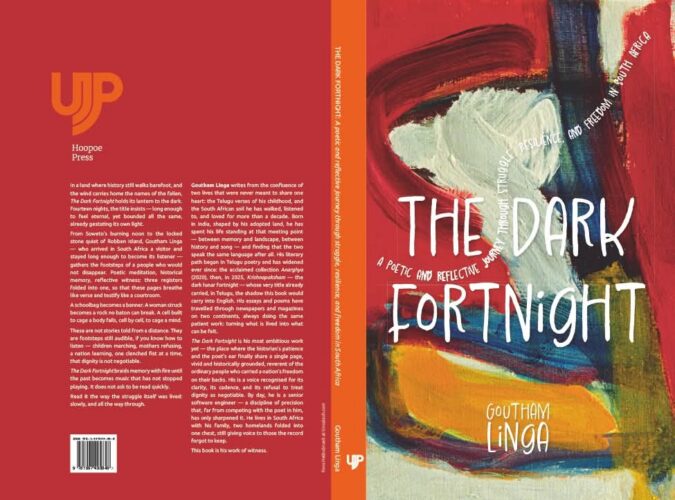
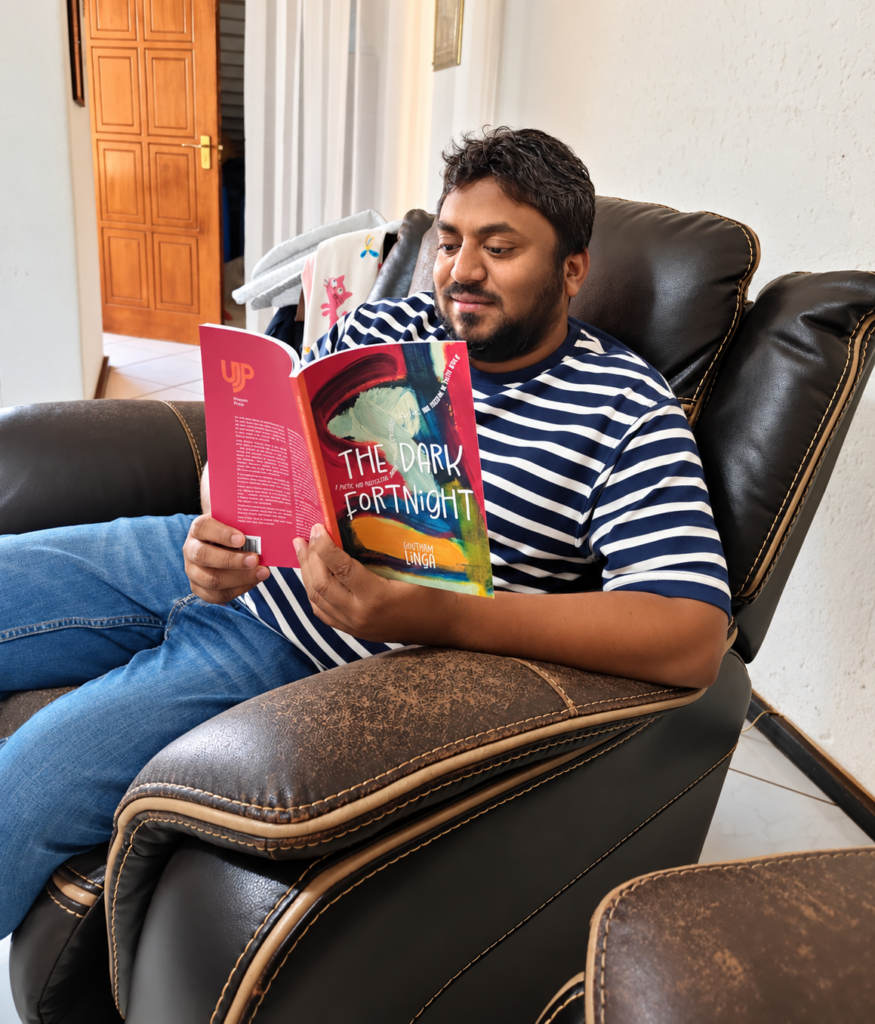
In his university-published collection, The Dark Fortnight, he transforms a red-blooded history into a canvas of human resilience. Moving beyond mere documentation, his writing connects the apartheid era’s shadows to universal questions of modern dissent and dignity.
In this interview, Goutham speaks on his journey from Satyanarayana Puram to Johannesburg and why a human life must never be reduced to a label.
Q1: Your journey as a writer has a very unique starting point, from Satyanarayana Puram, a small village 60 kilometers from Khammam, to working and writing in and about South Africa. How did this geographic and cultural shift influence your writing?
I think geography changed what I started writing about, but it did not change the person who was writing.
I grew up in Satyanarayanapuram, a small village about 60 kilometres from Khammam in Telangana. It was a very small place, but it gave me my first understanding of people, relationships and community. My childhood was surrounded by fields, festivals, relatives, neighbours, Telugu literature, small struggles and small happinesses. I did not realise then how much of that would stay with me.
I remember our festivals particularly well. When Vinayaka Chavithi came, we would bring marigold flowers from Subbaiah Pedananna’s field. Some things came from the nearby shops, and if somebody was travelling from Khammam on the Krishna Express, we would ask them to bring whatever else we needed. We did almost the same for Ramadan, Peerla Panduga and Christmas.
The festival changed, but the people did not.
Sometimes the coloured paper left after Peerla Panduga would be used to decorate the Sri Rama Navami stage. Nobody questioned it. Nobody said, “This belongs to your religion and not ours.” It was simply our village.
Looking back, I think that little village had an innocence and, in some ways, a maturity that I find missing in many much larger societies today. We did not have sophisticated theories about coexistence. We simply lived together.
Then I came to South Africa, and I found myself in a country with a completely different history. Here, I saw what happens when differences between people are turned into a system. Apartheid was not just an idea. It affected where people lived, where they worked, whom they could marry, where they could go and how they were treated.
That changed the way I looked at history.
In South Africa, history is not something you only read in a textbook. You see it in streets, townships, museums, monuments, names and, most importantly, in people’s memories.
My village taught me to observe people. South Africa taught me to observe history. Somewhere between those two experiences, my writing found its direction.
Q2: The Dark Fortnight evolved from your previous work, Krishnapaksham. Could you tell us about the stylistic choice of using “poetic prose” for these essays?
Krishnapaksham was an important stage in my writing because it helped me become comfortable with not fitting everything into a conventional literary form.
When I started The Dark Fortnight, I was writing about apartheid and a very painful period in South African history. There are many books that explain its dates, laws, political movements and major events. I was interested in what those events meant to the people who actually lived through them.
That is where poetic prose came naturally to me.
I did not want to write a dry historical account, but I also did not want to write a conventional book of poems. I wanted the facts to remain important while giving space to emotion, silence, imagery and rhythm.
A historical fact can tell you what happened. A line of prose can sometimes make you feel what it meant to someone.
That distinction matters to me.
So The Dark Fortnight sits somewhere between history and poetry. I wanted the reader to understand the history, but also to pause and feel the human presence behind it.
For me, poetic prose is simply a way of making history breathe.
Q3: The transition from your initial Telugu writings to an international English publication is remarkable. What was the editorial and review process like with the University of Johannesburg for The Dark Fortnight?
It was a long process, and a very humbling one.
I started writing in Telugu. That is where my relationship with literature and my emotional vocabulary as a writer were formed. Moving into English was therefore not simply changing languages. I had to think about how something that felt natural to me would reach readers from very different linguistic and cultural backgrounds.
The University of Johannesburg Press process was also quite rigorous.
The manuscript first went through five internal reviews. After the professors at the University of Johannesburg agreed to take it forward, it was sent to professors at other South African universities for six external reviews.
After the evaluation, the different inputs were considered and the manuscript moved towards publication. It then went through two language editors and two history editors, followed by almost a month of proofreading.
The whole process took about ten months.
As a writer, you become attached to your manuscript. You know why every section is there. But once you give it to reviewers and editors, you have to be willing to listen and reconsider.
That was an important lesson for me. Editing did not take away my voice. It made me look at my own writing more carefully.
And when the finished book finally came out, it was a special feeling. I had started writing in Telugu in a small village in Telangana, and years later I was holding an English book about South African history, published by a university press in Johannesburg.
It felt like two very different parts of my life had finally met.
Q4: How do you balance your professional life as a senior software engineer with the intense, patient demands of being a writer and observer of history?
I don’t really think of it as balancing two separate lives.
For me, coding and poetry are actually quite close.
I can write Java code poetically. Good code should not repeat unnecessarily. It should not be complicated for the sake of being complicated. It should say what it needs to say, clearly and directly.
Poetry needs something similar. You should not keep adding words when one word is enough.
I enjoy both. Sometimes I am coding and something comes to mind, so I stop and write it down. Sometimes it happens late at night, with the laptop open and code on the screen. I suddenly find myself writing a few lines of poetry in the middle of it.
I don’t see that as a distraction.
Software engineering has also influenced the way I look at history. When something goes wrong in software, I don’t stop at the visible error. I look for the cause underneath it.
I approach history in much the same way. When I read about an event, I want to know not only what happened, but what was behind it. Who suffered? Who benefited? What happened to ordinary people? What was left out?
So I don’t really separate the engineer and the writer.
One helps me understand systems. The other makes me question what those systems do to people.
Q5: Looking back at your journey, from your roots in India to your life in South Africa, where your work now stands accessible across borders, what message or sentiment would you like to leave with your readers?
My journey has made one thing very clear to me: our differences should never make us forget our common humanity.
I have lived long enough in South Africa to experience that personally.
A Pakistani Muslim cuts my hair. A young Jewish man sits next to me at work. A Black woman from Kenya smiles and speaks to me in the office canteen. A nurse from Ukraine helped bring my second child into this world.
These are ordinary people and ordinary moments, but together they have changed the way I see identity.
Sometimes I ask myself, after all this travel, which country do I belong to? Which religion? Which caste?
I still know where I came from. I love my village, my Telugu language and India. But I have also crossed many boundaries in my life.
I don’t think we need to give up our identities. We simply need to stop using them to make other people smaller.
For me, that is perhaps the simplest message I can leave with a reader:
Human beings are human beings. Religion, caste, class, race and nationality may describe parts of us, but none of them should determine the value we place on another human life.
That is not just something I write about. It is something I have experienced.
Q6: As an expat Indian living in South Africa, what inspired you to document the history and struggles of this land? What drew you to chronicle these local stories instead of focusing primarily on your own people and history?
It started with curiosity. After living here for years, it became something more personal.
When you live in another country for a long time, you start asking questions about the place around you. Why is a street called this? Why does a particular name carry so much emotion? Why does an event that happened decades ago still matter to people today?
South Africa kept giving me those questions.
And gradually, this stopped feeling like somebody else’s history.
I developed a deep affection for this land and for the people who have lived through its difficult history. I particularly admire the ordinary people who have survived through hard work and those who endured generations of humiliation and still held on to their dignity.
What stayed with me was not only the suffering. It was the ability to continue.
People lost homes, families, freedom and sometimes their lives, but they continued to stand and resist.
I also wanted to see South Africa without reducing it to a simple black-and-white story. I wanted to look at its different communities and histories with the same human eye.
As an Indian who came here later, I know that I cannot claim the lived experience of someone who went through apartheid firsthand. So I did not want to speak for them.
I wanted to listen, understand and then write.
That is what drew me to these stories. I found that the more I understood South Africa, the more deeply I understood the things that matter to me as a human being.
Q7: While writing about the historical struggles and apartheid history of South Africa, how did contemporary voices and political prisoners back in India, such as Umar Khalid, Professor Sai Baba, and Varavara Rao, influence your thoughts? Did you see an inner, invisible bridge connecting the historical suffering of the Black community there to our own country’s current socio-political reality?
Yes, I felt there was a connection, but I would not say that the histories are the same. They are not.
South Africa’s apartheid history has its own specific circumstances, and India’s present political and social reality has a very different history.
What connected them in my mind was a human question rather than a direct political comparison.
While writing The Dark Fortnight, I kept thinking about what happens when a system becomes more powerful than the individual standing inside it.
The public cases and voices surrounding people such as Umar Khalid, Professor G. N. Saibaba and Varavara Rao made me think about that question in an Indian context as well. Their cases have been discussed and interpreted differently by legal, political and public voices, so I think it is important to distinguish documented facts from interpretation.
But as a writer, I kept returning to the person behind the case.
What happens when someone is imprisoned? What happens when someone disagrees with power? What happens when a person becomes a label before they are seen as a human being?
That brought me back to apartheid.
Under apartheid, people were reduced to categories. Race could determine where a person lived, worked, travelled and what rights they had. The tragedy was not only discrimination. It was the reduction of a human being to a category.
That is where I see the invisible bridge.
Not between identical histories, but between human beings asking questions about dignity, freedom, dissent and the right to be heard.
History does not give us ready-made answers for the present. But it gives us questions that we should not stop asking.
I don’t want my writing to tell people what political conclusion they should reach. I want it to make them stop and think about what happens when we stop seeing people as people.
For me, that is the connection.
Different countries. Different histories. Different circumstances.
But the same human being underneath.
*


 పెద్దన్న మారబత్తుల
 శివలక్ష్మి
 Chandana Alluru
 విశీ
విశీ

 ముక్కామల చక్రధర్
 శ్రీరామ్ పుప్పాల
Add comment