
 Nandini Sen
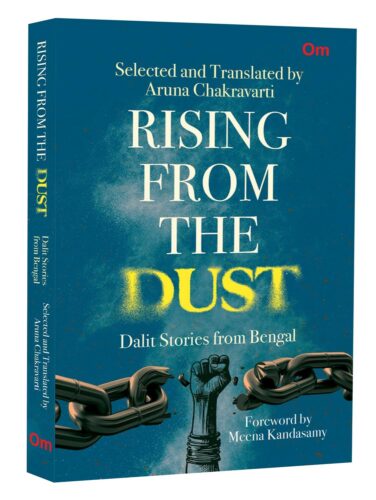
Rising From the Dust: Dalit Stories from Bengal (2025) translated from Bengali by Aruna Chakravarti and published by Om International is a carefully curated anthology of twelve stories showcasing the Dalit experience of Bengali communities with a distinct focus on women. Chakravarti’s selection of stories and writers is extremely purposeful. She chooses literary stalwarts like Saratchandra Chattopadhyay, Tarashankar Bandopadhyay, Mahasweta Devi and Prafulla Roy and adds contemporary voices such as Manoranjan Byapari, Bimalendu Haldar, Manohar Mouli Biswas, Kalyani Thakur Charal, Anil Ghorai and Nakul Malik. The choice of the writers and their stories span a century documenting the Dalit woman’s experience through the ages. The Foreword is by the noted Dalit poet Meena Kandaswami. The stories show the woman as twice colonized – dominated because of her gender and caste but she continues to remain feisty, gritty and bold, taking charge of her own story.
Chakravarti’s translated stories bring to fore the power of literature shedding light on those who go unnoticed; the margins that are never highlighted, slipping into darkness forever. Her stories accentuate the importance of translation in bringing the narratives of the subaltern to the forefront. Chakravarti’s translation helps shed light on the abject plight of Indian women in a society that oppresses them not only on the basis of their gender, but also caste, exposing the brutal realities of their lived experiences. These poignant stories, however, are not devoid of hope. True to the title of the volume, the women protagonists rise from the dust rising like the proverbial phoenix, who embody strength and resilience and refusing to allow the society to define them through the patriarchal lens.
Chakravarti’s sensitive translation of the Dalit literature from Bengal focusing on the women is a rarity. While subaltern stories from Bengal are often narrated, a collection such as this, focusing on the Dalit entity is unique and deserves praise. It also opens up a genre of Research in this area enabled by the translation.
The text depicts the language of these communities, reflecting the hard-hitting reality of the lives of the protagonists. The atrocities are conveyed so sharply that one feels the words pierce the hearts with pain, whether it pertains to the violence inflicted on Sarama in “The Fortress”, the terrorization of women by Nishay Ghosh in “Salt”, or the brutal murder of the female protagonist in “Shonkhomala”, the language encapsulates through detailed descriptions and metaphors, the decrepit state of these women, something which Chakravarti has skillfully captured in her rich translation, leaving readers with strong emotions and images imprinted in their minds.
Each story is a universe in itself, though they are thematically connected, as the reader comes face to face with every subjugated aspect of women’s lives. Chakravarti also skillfully tackles the collation of themes within the anthology, not only furnishing one with depictions of the Dalit women’s oppressive mundanity, but also how people practicing the heinous caste system view these women, and uphold these discriminatory traditions devoid of humanity. This is especially clear in the way the theme of love is woven throughout the collection. The story “Raikamal” by Tarashankar Bandyopadhyay underscores how exogamy would lead to the end of the caste system, how love breaks traditions and ridicules the notion of caste and the idea of purity. Yet, in the same breath, the difficult reality of inter-caste union is also showcased, as love that transgresses caste lines is punished stringently and considered an impossibility. A supernatural element is brought into this theme as Chakravarti includes the work of Prafulla Kumar Roy as well, among others, and each story makes use of the same, not as an avenue of escapism for the female protagonist, but a scathing social critique of their plight. The fantastical elements of the story, which comprise of Indian myths and superstitions as well, are translated in a way that the stories of these women do not paint a pitiful condition, but rather construct retributive figures who become independent, and transgress caste traditions, forging a new path for themselves. Even in death they remain a beacon of power and strength.
In addition to this, the collection does an excellent job in showcasing, stylistically and aesthetically, the startling normalcy of the protagonists’ lives. The language transports us to their kitchens and huts, whether it is the taste of gud or the howling of the winds on a stormy night, the anthology brings the reader into the universes of these women through the medium of literary imagination. The narratives are anchored in the women’s suffering for a reason; their abject lives are considered the norm –the violence, the hunger, the insults are all part of their realities. They are considered to be nothing but dust. The imagery constructed by Chakravarti forces the reader to take cognizance of the atrocities and feel a sense of shame for the way the upper caste treats the Dalit community. Chakavarti’s choice of stories is excellent – it delineates an era showcasing the nature of atrocities and their continuance inspite of the society’s transition into so called ‘modernism’.
Furthermore, the anthology also speaks about the 1971 divide that left many people with a sense of displacement and identity crisis. This dimension allows for the conversation regarding refugee conditions, underlining how caste is not a rural Indian problem that is contained within the borders of the nation. It bleeds into society in such a manner that even migration cannot reconfigure caste hierarchies. This can be witnessed in “Nalini’s story” especially, as it highlights how women are abandoned by men, but still remain stuck in the cycle of ritualistic existence. It is evident that the collection has brought Dalit women’s histories to the center through the collective narrative. Rising from the Dust is a documentation of the neglected women’s stories and historical archives of low-caste womanhood. It offers an honest view into their lives via the Bengali literary corpus that would have remained inaccessible to the Anglophone world, without Chakravarti’s endeavor.
The Translator’s note expressing Chakravarti’s motivation in curating the anthology makes it clear that the Dalit experience is not a homogenous one, on the contrary, as stated earlier, women are doubly oppressed, and their voices are silenced when they attempt to speak up. Meena Kandasamy’s Foreword reiterates these sentiments, as she emphasizes how the stories within the anthology do not merely recount the discrimination and oppression meted out to these women, but they highlight their defiance, their resilience, their power, and most importantly their survival, even after death.
This volume stands as a social testimony, for both readers and critics alike, as it exposes the harsh structural violence embedded within the Indian psyche against the low-caste women, while simultaneously underscoring their stubborn survival in the face of it all. Rising from the Dust insists on preserving the aesthetic dignity of the lives of these marginalized women. Aruna Chakravarti has provided researchers and general readers access to a remarkable literary corpus that deals with the topics of caste, gender and oppression within the realm of South Asia with her brilliant translation of the original works. Rising From the Dust is an ode to womanhood and selfhood as it redefines the concept of Dalit feminist consciousness in Bengal.
*


 పెద్దన్న మారబత్తుల
 సుజాత వేల్పూరి
 మునిసురేష్ పిళ్లె
 శాంతి ఈశాన్
 మానస ఎండ్లూరి
 భరత్ కనికె
 ముక్కామల చక్రధర్
Add comment