
 Lakshmi Kannan
Nivedita Louis, author, researcher, feminist and social activist, is presently the editor and Co-Founder of Her Stories, a publishing house that is blazing a trail with the writings of women in Tamil, giving them a valuable platform to voice their thoughts. With Vallidasan, a scholar and a friend of women as a working partner, there is no stopping them.
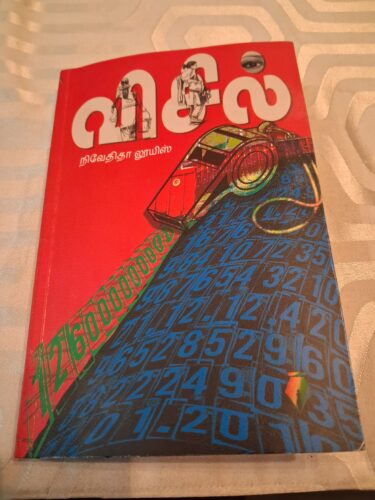
Louis’s book Whistle was launched recently in this year’s Book Fair in Chennai with the distinguished literary historian Prof. Prema Rathinavel as the keynote Speaker who introduced the unique features of this personal narrative to a captive audience. It covers the author’s early years when she worked as a young trainee with the Indian Railways, a position she earned through several grueling rounds of qualifying exams after the R.R.B. (Railway Recruitment Board) exam. Like with many organizations, it entailed working within the challenging rigidity of a hierarchical structure. Her tenure as a commercial clerk with the transshipment depot and weighbridges taught her a lot.
Her Introduction (Arimugam) opens with humility coupled with an irrepressible sense of humour which characterizes Louis. She looks back at a seemingly innocuous incident that becomes a defining moment for her self-actualization. A student asks her if she was in the Kallukuzhi counter between 2009-2012. Taken aback, she asks him how he could tell when she was just an arm jutting in and out of an iron grill to issue tickets? She wonders if she ‘fought with him over change, or said that she couldn’t give him a ticket, or got angry with him?’ Not at all, Ma’am, says the boy. He remembered her for always being engrossed in reading books, in between work. Louis recalls reading Paolo Coelho, the Brazilian novelist. So the hand that mechanically extended beyond an iron grill a hundred times in a day got a ‘face’. Her face.
This trait marks her narrative throughout the book. A tendency to introspect, to question herself along with others with a healthy curiosity about the work culture of the Railways. They are tempered with humour laced with satire and vivacity, an ammunition that keeps her sane, grounded and focused on work. When Kevin, the boy who professes ‘love’ circles around her, she reminds herself to avoid ‘kaadal, katthrikkai’, a typical dismissal in Tamil, like they say ‘love, shuv’ in Hindi.
Very early on, Louis realizes the grave risk to her life, and the lives of her loved ones if she speaks out. The day her small son informs her someone stood at his school gate and asked him if he was her son decides her course of action. Still, to emphasize at this point about her being a married woman with two small children and an ageing single father to look after would be a willful fallacy that denies her personhood. The woman, the mother, the Railway commercial clerk working with trans-shipment depot and weighbridges are inseparable.
What is more significant to note is her moral indignation, what is called a dharmika kobam in Tamil, that is seething within her. Unafraid, she decides to write a personal narrative, recording all that happened in her professional and private life with intellectual honesty. The book has excellent endorsements. Former Justice K. Chandru from the Chennai High Court, a legal luminary, calls her a “dairiya Lakshmi” (a brave Lakshmi) and the eminent writer M.A. Susila commends her courage, comparing her book to Gandhiji’s My Experiments with Truth. Louis stands tall, head and shoulders above her peers and seniors in rank.
Avoiding the first- person pronoun, Louis’s narrator is a ‘She’. Perhaps it gives her a distance from herself. At first glance, Whistle unfolds like a crime fiction in which ‘She’ is an indefatigable sleuth, out to uncover the persons behind all the wrong doings in the Railways even while she realizes that her investigations – done quietly with colleagues she trusts – may only stir up the proverbial hornet’s nest. People have normalized corruption. Nevertheless, something eggs her on. We follow her every movement in the brisk, edge-of-the-seat narrative, fully aware of the risks to her life, even if she had taken a silent decision not to be a whistle blower like Julian Assange. But everyone knew by now that she has a whistle in her hand. The details of what follows are best left to the reader who turns the pages of this gripping book.
Louis’s entire being rebels against the systemic rot. Her conscience does not let her sleep. The employees function within appalling working conditions. As always, there is extra pain for women, not just the discomfort of wearing sarees but equally the embarrassment of common bathing rooms for male and female, unhygienic wash rooms, dirty ‘office’ space, long working hours with no break for food. Add to this the invariable sexual harassment for women who work till late hours. Even married women are not spared by the wolves. If a woman rebuffs, men resort to vengeance. We should subvert the oft-quoted line paraphrased from William Congreve’s play to read as: ‘Hell hath no fury like a man scorned.’ (The Mourning Bride). It is plain misogyny masquerading as sexual harassment, a cheap ploy to intimidate the female work force so that they leave their jobs. Additionally, Louis reaps typical appellations – Chandi Rani, Adanga Pidari (a rebellious girl), Vayadi (too outspoken) and Jhansi Rani to which she retorts: ‘If the Rani had a sharp sword, I have a sharp tongue’.
The women show their mettle by working tenaciously, through menstruation, childbirth and sicknesses. Louis works through her low phase when she is diagnosed with atonic seizures. The prescribed neurological medicines have terrible side effects. A painful abscess develops below her left breast with pus formation requiring surgery. One can only imagine the challenge of staying ‘dry’ through her work hours, not to forget the excruciating pain. She works on, undaunted.
Mercifully, there are some angels. Richard Sir, Mohan Sir and his wife, Pandian Sir, Vigilance Sundar, Comrade Gopalan in the union, and finally Francis, the Goanese survivor of 9/11 in Mumbai who declares affectionately that she is his sister, stuffing her hands with sweet candies.
Two distinct strands run neck and neck in her narrative. One is her uncanny wizardry in numerology and the mystic connections of numerals. They haunt her wherever she goes, with her astounding memory. Interestingly, all the chapters are mentioned in numbers. The other is an equally adhesive memory for recalling some of the profound lines from Shakespeare and other poets she heard from her mother, an English teacher. As a voracious reader, she is consumed by a hunger for wisdom culled from the eclectic range of her reading. All of these guide her through the most perplexing situations and help her gain a stoic acceptance of life with a philosophic outlook. Even as a small girl, she quotes lines from Shakespeare’s Hamlet, ‘The heart-ache and the thousand natural shocks that flesh is heir to’ to her friend’s uncle. The special Friday Puja in her office that she watches mutely, along with Muslims, makes her think of Joseph Heller’s Catch – 22.
Whistle has an informal, friendly style peppered with the slangy speech rhythms of street language even while noting the unsettling truth around her. It would be great to read a review of this book by a numerologist for perspectives that escape a lay person. How do the magical numbers 3 6 9 function? Louis could have easily slipped into the role of a professor of Math, but the wish to write came as a calling.
Finally, one does hear the whistle blowing. From a rice cooker, coming from the house next door.
Whistle by Nivedita Louis. Her Stories, Chennai. 2025, First Edition, 2025 December. Rs. 350/- ISBN: 978-93-48641-93-9. 272 pages.
***


 పెద్దన్న మారబత్తుల
 సుజాత వేల్పూరి
 మునిసురేష్ పిళ్లె
 శాంతి ఈశాన్
 మానస ఎండ్లూరి
 భరత్ కనికె
 ముక్కామల చక్రధర్
Add comment