

 Lopamudra Banerjee
Dr. Shoma A. Chatterji is a freelance journalist and film critic of 48 years standing. She has to her credit 34 book titles under prestigious imprints, including 5 short story collections, 19 books on India Cinema, 1 book on urban history and 1 book of translation, 8 books on gender issues. Two more books on Indian Cinema have just been picked up by a global publisher to be published later this year.
Among her coveted awards, she has won the National Award for Best Film Critic in 1991 and for Best Book on Cinema in 2002, and also 2nd Prize at the Sahitya Akademi’s Golden Jubilee Translation contest (for her English translation ‘The Search’, original story by Shirshendu Mukhopadhyay). A Senior Research Fellow at the National Film Archive, Pune, she has done extensive research on men directors’ perspectives on women, and also as part of her Senior Research Fellowship at PSBT, Delhi, she has researched on the politics of representation of women in Indian television and media. With Masters’ Degrees in both Economics and Education, both from the University of Bombay, a PhD in History (Indian Cinema) and a PG Diploma in Journalism and Mass Communication, she is considered a veteran film scholar, a master storyteller and an authority on cinema and allied arts, art and culture. She is also the recipient of several Lifetime Achievement Awards for her contribution to film journalism, gender studies etc.
Being an ardent admirer of Shoma di’s huge body of academic and journalistic work since quite some time, it was my great privilege to document her perspectives on fiction writing and her own style of storytelling, translation, and also her insights on various aspects of cinema and the modern media.
Lopa Banerjee: Shoma di, welcome! I have been following your published articles, reviews and criticism on films and allied arts since quite some time now and also recently had the privilege to read the very poignant stories in your recent short story collection ‘Walking in the Rain’ (Penprints Publications, 2025) that is full of hard-hitting epiphanies and realistic, postmodern images of urban life depicted in each tale with rare subtlety and finesse. This is your fifth book of fiction, and your fiction writing started years back with the publication of your debut book of stories, ‘Yes And Other Stories’ (Writers Workshop, Kolkata). All this while, you were also frequently writing books on Indian Cinema, history, popular culture et al as a researcher and critic. I’m curious to know, how did your transition from writing nonfiction to fictional stories happen? Do you enjoy the straddling between the diverse genres of writing?
Shoma A Chatterji: It was not a conscious shift from non-fiction to fiction. It happened naturally when Eve’s Weekly, a wonderful women’s magazine (now extinct) declared short story contests. I was surprised when two of my stories won the top prize in two different contests. I used to write articles on gender in the magazine and the editor, the late Gulshan Ewing, was helpful with suggestions. In those days, when I was barely in my twenties, editors were very grounded and accessible and you could just walk in without any prior appointment and introduce yourself. I had not begun to write on cinema because that space was already filled with known names and no one was ready to welcome a newcomer, especially a freelancer. I was writing books on gender and NOT on cinema, which came much later after we migrated from Mumbai to Kolkata in July 1995. I became a freelance film journalist while I did my postgraduate diploma in Journalism and Mass Communications in 1981 where I topped the class.
By then, I was mother to a teenaged girl, running a family and also working fulltime as a lecturer in a nearby college where I taught Economics for 13 long years. Before that, I taught English in a school in Sion in Bombay between 1974 and 1978 and my professional journalism began around that time. But still, I was writing on gender and sometimes, on gender and media. By the time we migrated to Kolkata, I was already a known freelance journalist writing on cinema mainly and often on gender. I was a regular columnist for SCREEN, a wonderful film broadsheet from the Indian Express Group in which I continued for 32 long years till SCREEN closed shop and was taken over by a different owner. My first two books on gender and my first book of short stories were published in the late 1980s before we came to Calcutta. I was totally against this shift because it drowned my earnings completely but my husband had resigned from his corporate job and our daughter sided with him. In 1995, I was a full-time freelance journalist earning a neat sum of Rs.22,000 per month solely from journalism as I was very prolific and extremely professional. In Calcutta, my earnings became zero and it took me another ten years to get back on the saddle. This is one major drawback of being a woman. This, despite my having already won my first National Award in 1991. A woman’s “NO” is never taken seriously and I am no exception. I enjoy this straddling but mostly, I am busy writing non-fiction, so…..
Lopa: While I was reading some of the stories in the collection ‘Walking in the Rain’, including the title story, ‘Quitting’, ‘The Handkerchief’ and more, I was swept by the subtle treatment of the feministic themes that you have in the stories. In the story titled ‘Award-Winning Recipes’, you have portrayed a woman’s ordeal with family chores, domestic rituals and cooking that she despised, is a sharp commentary against our Indian patriarchal system, though in a metaphorical vein. How has your inherent feminism been shaped by your own journey as an author in the stories?
Shoma: For this, I must thank my late mother-in-law. She tortured me mentally and psychologically for all the nine years I lived in a joint family in Calcutta. She would insult and ridicule me all through those years though I tried to fit myself in as a very dutiful and obedient daughter-in-law. She was beautiful, talented, trained in Hindustani classical music, played the piano, all of which were drowned in giving birth and looking after six children born one after another. I could understand that she was taking out her frustrations on me but I began to feel restless. My husband, the eldest of three sons hardly interfered because he was working in his father’s firm and could not take the risk of walking out. I felt restless and began to believe that I can come out of this if I begin to work and it worked. But if she had been a wonderful mother-in-law, I would have ended up being a wonderful daughter-in-law and neither a film critic nor a film scholar nor a journalist. Right? One thing I have learnt in my life. A woman is capable of turning liabilities into assets. I did this quite unconsciously, but it was worth the while.
I finished my Masters in Economics from Bombay University where I lived with my parents for a year. I came back and gave birth to our only daughter and then did my B.Ed. and got a First Class from Calcutta University. But when our next daughter died in childbirth, I put my foot down and decided to go to Bombay and begin life again. I had no job and no money but this time, my husband backed me. He could not imagine that I would decide to settle down in Bombay but I did. I got a school teaching job, lived with my parents and my husband would visit now and then. I also did my M.Ed. and my Diploma in Journalism. But I was not ready to go back, come what may. His father had passed away by then and he too came down to Bombay. We bought a tiny flat in Mulund with the money he got from selling a plot of land in Kolkata and we lived in that flat for 21 long years. He got a very good job in a multi-national firm, I was teaching in the local college and our daughter was in a local school. When we came to Calcutta in 1995, she was already a graduate, had done a post-grad diploma in Sales and Marketing and got a job at the Taj Bengal where she met and married her husband in 1998. I too, did my Ph.D. in History (Indian Cinema) at the ‘young’ age of 65+ followed by a post-doctoral research fellowship from the ICSSR, Delhi. Over time, I have become extremely research-oriented so often, I feel editors moving away from me because I just cannot write light, frothy and flighty articles. But I never blame those who do.
Lopa: The concept of ‘home’ or the ‘marital home’, or in other words, the familial world, as we women perceive, very often become unhomely, and are somewhere metaphorically and symbolically challenged in your fictional stories in ‘Walking in the Rain’, which is very aptly pointed out by Dr. Sanjukta Dasgupta in her brilliant foreword to the book. What is your own take about the concept of such ‘marital homes’ in Indian family structures and what ethos do you have about such a subject?
Shoma: According to me, the concept of ‘home’ is not physical with a flat with rooms divided by concrete walls where members of a family live. It is more of an abstract ‘idea’ expressed physically with members of a family living under the same roof. It is YOU who makes the home, NOT the walls, the furniture, the décor and so on. And by ‘you’ I mean the wife who labours from morning to night without reprieve, without saying “no” to anything and without even being aware of the truth that she has the right to say “no” when she is tired, bored, angry or happy.
This underlying philosophy of life guided me in my meaning of “home.” My own mother was forced to leave home and hearth after 42 years of marriage and three married kids when my father and brother decided to get rid of her as her ‘productivity’ had ended and the daughter-in-law was there as a substitute and supporter! Fortunately, my husband offered to take her responsibility entirely and she lived with us for 18 years from 1983 till she passed away in 2001. She was a wonderful cook, stitched our clothes when we could not afford a tailor, took care of our studies and took great care of her husband. She also wrote poetry and left behind four books of poetry, two in original Bengali and two translated into English by me. But as they never divorced, she fought for her widow pension and won! Salman Rushdie believes in the integration of cultures and identities and goes on to denounce the idea of a nation, a culture and even home. I agree with him.
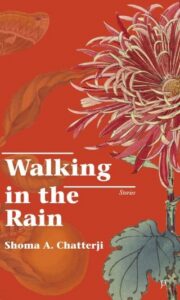
Lopa: The stories in ‘Walking in the Rain’ led me to read and internalize some of the stories in your previous book of short stories titled ‘Backlash—Shero Stories’ (Notionpress, India), which are based on true life experiences of different women in Indian society, including the title story that challenges patriarchy again with a memorable twist in the tale and also a hard-hitting message regarding gender identity in the end. Do you think/believe such stories are essential to pen, more as subtle social commentaries than merely fictional tales?
Shoma: Yes, I did not deliberately design the stories to carry any ‘social message’ but if they turned out to be so, I am very happy about them being interpreted like this. For example, the story in Sheroes that goes “My Mother’s Transistor” is based on the real story of my mother who once bought a transistor from her savings but was never allowed to listen to it at home as she played it at full volume and it disturbed my father and my brother so she would take it out at night after her chores were over and go and sit at the entrance gate and listen to any and every kind of music, never mind the language. She was hard of hearing. But the end of my story is fictitious entirely. ‘Candy Floss’ is another story based on two different childhood experiences I shared with my mother, sister and brother. But the metaphor is completely fictional, born out of my imagination. The painting I saw at the exhibition is also based on fact. ‘Hair’ is a fictionalised narration taking off from my mother-in-law’s habit of pulling off her hair till she became almost bald and hid it under layers of kajol smeared on her scalp when guests came. ‘The Girl Who Wanted to Become a Tree’ is inspired really by a short telefilm in Gujarati I had watched while in college on our black and white TV. The impact of the story never left me. Of course, I expanded on it and it became my original story.
Lopa: Apart from your original fiction writing, I know that you have also received the 2nd prize at the Sahitya Akademi’s Golden Jubilee translation contest for translating renowned author Shirshendu Mukhopadhyay’s story ‘The Search’. How does modern Bengali literature inspire you in your translation work and why did that particular story appeal to you? Do you think translation is a significant cultural bridge between languages and cultures?
Shoma: Shirsendu Mukherjee is my most favourite author among the post-Colonial Bengali authors. I was commissioned by Sahitya Akademi to do a book of translations of a few selected short stories authored by him. The story which won the prize was one among those. But let me tell you, I am no translator. You need to have mastery over both the original and the translated language to be a successful translator. I am not that. Besides, this work was very difficult for me and the Sahitya Akademi went on sending it to one expert after another, till I got fed up of redoing the same stories. So, when this story bagged this coveted award, no one was amazed like I was. Translation has now turned into an independent area of literature, so it is no child’s play anymore. I have lots of friends who have become specialists in translations, though they also write their own works. I thoroughly enjoyed your work on the Tagore women, though I never read the original. I have deep regard for those who are excelling in translation work and contributing to the scholarship and global readership.
Lopa: From your fiction writing and translation work, now let us veer towards your writing journey that is centered on Indian Cinema. As a veteran film journalist, film scholar and critic based in Kolkata, how has the city (Kolkata) inspired you as the epicenter of films, theater, art, culture and entertainment and how has it evolved now? Is it only out of academic interest that you started to write critiques and commentaries on Indian cinema, its history and its various aspects, or is it a deep-rooted passion for all art forms?
Shoma: Your question is right, but the place is Mumbai (Bombay) and not Kolkata. I was born, brought up and educated in Bombay. Later, in 1974, I went to live in Mumbai again and lived there for another 21 years. So, it is Bombay that has inspired me much, much more than Kolkata ever can. Bombay still has a deep impression on me, both personally as well as professionally. My childhood memories of growing up with my brother and sister, both of who I am still very close to, my memories of living with my parents, change of schools, learning to speak and understand Marathi as if it was my mother tongue, my love for Marathi festivals and food alongside Bengali, will remain etched in my memory. I switched from training to be a dancer through becoming a teacher and then a journalist and an author, all happened in Bombay. I left my friends, my natal family, my flat and even my profession behind when we migrated to Calcutta, much against my express wishes.
I still hold Bombay very close to my heart as it is very professional, people are no-nonsense completely and at least Maharashtrians are honest people. Calcutta in my life, can never replace Bombay though I have now spent 40 of my 82 years in this city. The people here are intellectually arrogant but friendly, yet you do not grow long associations with this city like I did in Bombay. I have accepted Calcutta into my system, even internalized it because I became a film scholar here, flourished as an author and a journalist though it took me ten long years to be even acknowledged.
My becoming a film critic began in Bombay when I had just got admission at Bombay University. The editor of FORUM, Mr/ Joachim Alva, MP, husband of the speaker of the Rajya Sabha Violet Alva, was the editor. Later, his daughter-in-law Margaret Alva became a minister. The magazine was a political monthly. He encouraged me to write one review of any film for each issue. I jumped at it. He paid me Rs.15 per review, plus the price of two balcony tickets. I would take my maa along for films like ‘Nartaki’, ‘Sahib Bibi Aur Ghulam’ and even ‘Gone With The Wind’. That is how my journey as a film critic began.
Then, a journalist friend of mine, Sanjit Narwekar, gifted me with a copy of FROM REVERENCE TO RAPE (It was out of print then) by Molly Haskell and suggested I write a similar book along the lines of this one, but focussed on women in Indian cinema. I began the book when we were still in Bombay but it got finished after we had already migrated to Calcutta. This book, titled Subject Cinema, Object-Woman, a Study of the Portayal of Women in Indian Cinema remains one of my most favourite books because I did a lot of research and my husband a civil engineer, opted to become also a publisher just because I could not land one. This book is now out of print but the publisher has just 12 copies left, if anyone wishes to buy one. This happened in 1998 and by then, I was a known name because of my first National Award in 1991. He won the National Award too because he had published my book on Aparna Sen as the Publisher of the Best Book on Cinema in 2002.
[Some notable books on cinema by Shoma A. Chatterjee]
Lopa: As part of your senior research fellowship from the prestigious National Film Archive in Pune, your academic work has focused on men director’s perspectives on women through their films. In Indian Cinema, our stalwart directors including Satyajit Ray, Mrinal Sen, Ritwik Ghatak, Buddhadeb Dasgupta, Rituporno Ghosh (from Bengal) and Shyam Benegal, Adoor Gopalkrishnan, Guru Dutt, Govind Nihalani to today’s new age directors like Vishal Bharadwaj, Mani Ratnam—all of them have had their unique perspectives and visions in their representation of women as a huge kaleidoscope of emotions. I am curious to know your insights on these visionary filmmakers and how in your research and writing, you have addressed their visions on womanhood.
Shoma: You will find more of this when my book THE MALE GAZE REDEFINED IN INDIAN CINEMA which has been taken on by a globally renowned publisher is published later this year.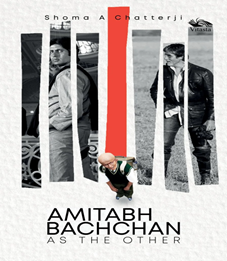
Lopa: Your exceptionally written book about Bollywood’s greatest superstar Amitabh Bachchan, ‘Amitabh Bachchan as the Other’, which I had the honor to review, is quite a scholarly take on the actor’s evolution of persona in the films where he was a leading man, with essays that emphasize on the haunting image of Bachchan as the ‘Other’. What inspired you to write the book, and how do you think the essays in the collection have shaped your perception about a significant aspect of Indian cinema?
Shoma: A friend of mine who worked in a top gazette rank in Delhi had done her Ph.D. on Bachchan. Bachchan had invited her to his home as a house-guest for a week or so. She gifted me with the two books and they were like revelations for me. I had already interviewed Bachchan not once but three times and was an avid fan of his as an actor. But when I felt I needed to write a book on him, I was stumped because there were just too many books on him in many Indian languages. So, devoid of ideas, I gave up, though my publisher, Vitasta Delhi, had given me the go-ahead. Then, after a gap of three long months, suddenly, I struck on the idea of Bachchan as “the other.” I shared my thoughts with my Delhi friend and she jumped at it. She said, “Go Ahead” and I did. Bachchan sent me a letter on his letterhead congratulating me for the book and it was signed by him too. But to be frank, the publishers inform me that the book is not selling at all though my book on Ray is selling very well.
Lopa: You have already won two national awards for Best Writing on Cinema, which bears testimony to the exemplary nonfiction writing that you have done on cinema as an integral part of popular culture. In 1991, you have been a recipient of ‘Best Journalist on Films’ and in 2002, your book ‘Parama and the Outsiders—The Cinema of Aparna Sen’ has been awarded ‘Best Book on Cinema’. Incidentally, you are also the only woman to have bagged these awards from the Ministry of Information and Broadcasting, Delhi, India, which is a remarkable feat. Can you let us readers know if your film writing is an extension of your social ethos and consciousness about the existential human conditions? Also, can you share with us some insights on writing ‘Parama and the Outsiders—The Cinema of Aparna Sen’?
Shoma: I was a great fan of Aparna and had met her many times other than watching her directorial films. I had interviewed her, reviewed her films and visited her at her earlier residence. I knew her father, the late Chidananda Dasgupta very well. So, suddenly, I felt, “why not a book on Sen as a director?” She was quite happy and handed me all the scripts of all her directorial films in advance. I really did not know what to do with them. But then, as I began writing the book, the scripts became a good frame of reference as they clearly gave me a glimpse of her evolution as a director who works very hard on her directorial works. It is the first auteur study of an Indian woman director in India. Sadly, it finds no mention in the documentary on Aparna made by Suman Ghosh.
I also wanted to include a long personal interview I had done with her in the book. But she went on telling me that I always quote her out of context which was wrong. When I asked her to give me live examples from my published articles, she could not. So, I decided to keep the interview out of the book entirely. She did not like it at all but my mind was made up. Since then, she has been quite cold towards me. But the actual writing of the book, my research on auteur criticism, my intensive and extensive studying of her directorial films, watching her at her shooting for four continuous days, watching her films again and again, was a memorable learning experience and I am indebted to her for that. It taught me how to write a really in-depth book on any Indian filmmaker.
Lopa: Some of the stories penned by you, I felt, have strong visual/cinematic elements in them. Do you have any story/stories that you have written, which you would love to see evolve as a film script or a theatrical adaptation in the near future?
Shoma: This is quite interesting. In fact, the first story BACKLASH, from the book with the same name, has been picked up for a short film by a madcap director who is a friend of mine. I have not watched the finished film yet because he is putting the colour corrections right now. But I never ever think of my stories being made into films because I know with certainty that the story can change completely when turned into a film. The same, I guess, has happened to this film as well. In that case, it fails to remain my story. Right?
Lopa: Shoma di, these days, since the advent of Facebook, Instagram, Twitter et al, there has been also a profusion of the online media, e-journals and portals that feature our writings on art, cinema, entertainment, politics and more, with instant readership and gratification that surpasses the readership that newspaper articles used to have. However, the flipside is that today, the general audience have a significantly low attention span when actual reading is concerned (as opposed to browsing). Being a veteran writer and critic associated with the media for a long time, what is your perception on this evolution of the media?
Shoma: To tell you the truth, I am completely disillusioned by this flooding and over-exposure of every written word, picture, reels and so on thrust on us without our say-so. Who will read my books five years from now? My freelance journalism has dwindled from 14 outlets to just three or four, of which only two are paying papers, that too, only digital. I am really scared. Everyone is a writer. The cell phone tells you that if you are ready to shell out the money, some publishers will write, print, publish and market your book and even fetch you a prize. If that be the case, what about ethics? What about the quality of writing? Can you imagine someone else writing your book and the finished product carries your byline? Thank God I might not live to watch the outcome.
Lopa: Thank you for your beautiful analysis and insight, Shoma di! I thoroughly enjoyed this conversation and hope it reaches plenty of readers in the near future.
Lopamudra Banerjee is a bilingual author, poet, translator, editor, playwright, script writer and writing mentor with ten solo books and seven anthologies in fiction, nonfiction and poetry. She has received the Journey Awards (First Place category winner) for her memoir ‘Thwarted Escape: An Immigrant’s Wayward Journey,’ the International Reuel Prize for Translation (2016) and also International Reuel Prize for Poetry (2017) and other honors. Her poetry has been published in renowned platforms including ‘Life in Quarantine’, the Digital Humanities Archive of Stanford University. Her collaborative poetry collection with Priscilla Rice Titled ‘We Are What We Are’ (Black Eagle Books, 2022) has been 1st Prize Winner at New York Book Festival 2024 and her translation of feminist poet and scholar Mallika Sengupta’s biographical novel ‘The Bard and His Sister-in-Law’ (Black Eagle Books, 2023) has received Honorary Mention at Paris Book Festival and Hollywood Book Festival 2024.
*


 పెద్దన్న మారబత్తుల
 శివలక్ష్మి
 Chandana Alluru
 విశీ
విశీ
 సంజయ్ ఖాన్
 ముక్కామల చక్రధర్
 శ్రీరామ్ పుప్పాల
Add comment